Choosing Adaptive Security: make training reports explain who still needs to learn
Adaptive Security’s short courses and reports can suit security teams managing ongoing training. Acceptance should go beyond completion rates: use fictional records to check denominators, reasons for non-completion and reporting boundaries before judging the administrative savings.
If your security team spends every month finding people who have not completed training in spreadsheets, Adaptive Security deserves a place on the shortlist. Judge its value by whether it reduces that administrative work, not just by fresh-looking courses and polished charts. A useful procurement acceptance goal is that the owner can explain who needs further learning, why, and who may see those records. This article covers procurement for defensive security awareness training only, not the creation or execution of attack simulations.
Adaptive’s official launch announcement describes three-to-seven-minute training modules for desktop and mobile, covering emerging threats such as deepfakes. A separate reporting announcement says the Reports Tab offers more than thirty templates, results broken down by department, location or manager, XLSX, CSV and PNG exports, and scheduled report emails. These capabilities offer training owners a way to reduce preparation and forwarding work. They do not themselves prove that employees have learned to identify risks, much less that security incidents have declined.
Ask the vendor to explain one number using fictional records
A procurement demonstration need not connect a real employee directory or send test messages to anyone. Ask the vendor to explain its calculations using demonstration data without real identities. Suppose a table has twelve records: two duplicates of accounts with unfinished training and two former employees who had not completed the course. Of the eight people who should participate, six have finished the course. Using twelve records as the denominator gives fifty percent; using eight eligible participants gives seventy-five percent. This is a hypothetical acceptance example. The aim is not a better-looking number, but a clear reason and traceable basis for every inclusion and exclusion.
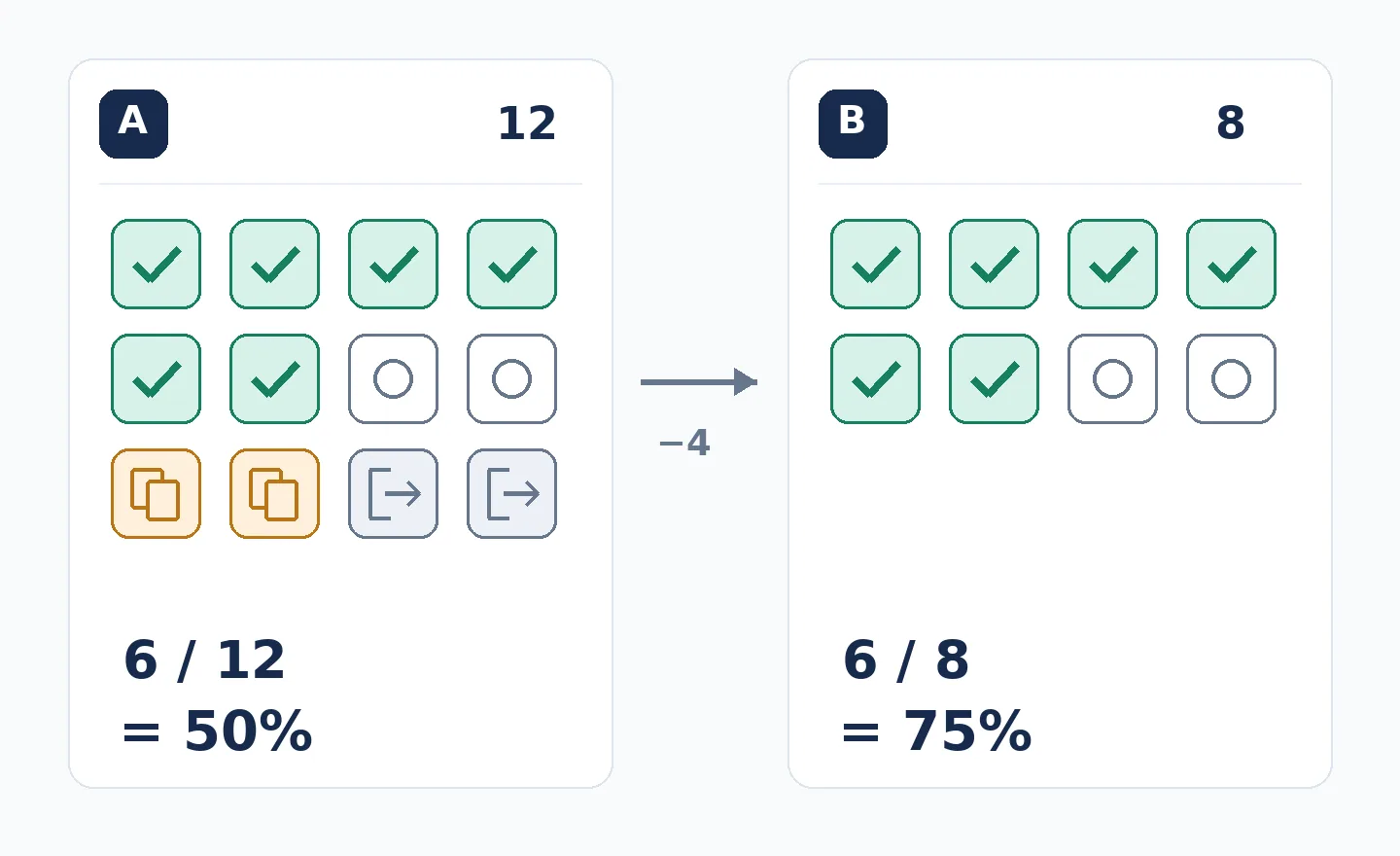
Original hypothetical illustration, not product UI. Green checks show six completions; hollow circles show two unfinished participants. A also includes two duplicates of accounts with unfinished training (stacked cards) and two leavers who did not finish (exit arrows); B excludes those four entries. The difference between 50% and 75% comes from the denominator, not improved learning.
Next, check whether the reports can distinguish unassigned people, those not yet started, those started but unfinished, and those no longer in scope. These are distinctions the buyer should request in a demo, not capabilities fully confirmed by public documentation. The three announced export formats have different roles here: PNG is useful for presentation, while XLSX or CSV suits row-level roster checking. Require a reconciliation of summary and detail for the same scope, explaining how staff changes or filters affect the denominator. If an administrator still has to investigate every person to explain a chart, more report templates have not removed the main manual cost.
Assess completion records separately from learning objectives. Select training relevant to the organisation’s policy and have the security owner check whether learners would know where to seek help and which issues require escalation. Watching to the end, passing a quiz and handling a real situation correctly are different measures. If the purchase is meant to reduce training administration, compare the time needed to prepare rosters and reports. Do not convert a change in completion rate directly into reduced attack losses or return on investment.
Reports can be sent, but to whom should they go?
The official announcement specifically says scheduled emails can reach managers or executives without administrator accounts. That simplifies reporting, but makes recipient scope a procurement question. Ask for a demonstration of what department heads can see, whose access to delivery needs removing after a role change, how long attachments remain, and whether only summaries can be supplied without individual details. These are permission and data-management requirements to verify, not guarantees about existing controls. Do not upload actual employee records merely to make a demo convenient.
Reporting integration is another easily underestimated prerequisite. The same announcement places a Reporting API for connecting BI tools on its future roadmap. That announcement alone cannot establish a delivered capability for a procurement plan. If your team needs automatic feeds into an existing dashboard, require confirmation of the available interface and delivery scope. Otherwise, count manual exports, field preparation and dashboard updates as labour costs. Even without integration, duplicate-account cleanup, manager mappings and recipient lists need named owners.
Keep contract and trial scope tied to the same objective: which training content, reports and administrative permissions are needed, who maintains the population in scope, and who resolves disputed records. For the same training scope, compare the administrative hours spent in the existing learning platform or spreadsheet workflow alongside the vendor’s written quote for the required courses, reports, administrative permissions and implementation work. If an existing learning platform covers courses, reminders and reliable completion records, and the team does not need additional security-content management, switching may not be worthwhile. Conversely, if relevant courses and recurring reporting consume substantial time, and a demonstration clearly explains rosters, denominators and recipients, Adaptive Security has a stronger adoption case.
The procurement evidence to retain is a sample report traceable from summary to detail, with exclusion rules explained and unrelated personal information kept out, plus a named follow-up owner. An attractive completion rate is only a displayed result. Helping the team identify which training needs follow-up and who will handle it is what can justify this type of platform’s deployment and maintenance effort.
Content note:This article is based on publicly available information and is intended as a reference for evaluating tools. Features, pricing, and related policies may change at any time; please refer to the latest official information.
Original source:www.adaptivesecurity.com