Can Aegisora be an approval gate? Test three simulated requests first
Use a procurement test with no real data to see whether allow, review and block match dummy execution outcomes.
Aegisora's August 10 repository snapshot describes ALLOW, BLOCK and ESCALATE plus a human review queue. This is a starting point for evaluating the design and implementation, not a production guarantee. Check whether the three decisions change what actually happens in a simulation, rather than just changing a dashboard label.
Use an isolated environment and a no-side-effect stub
Send three fictional requests from the same agent: A reads test inventory, B asks for approval to edit a dummy label, and C asks for a disallowed cross-project action. Connect only a stub that records what would have happened. No real databases, inboxes, customers or credentials. Set expectations first: allow A, review B, block C. Verify that B cannot execute without approval and that only the exact listed request is processed after approval.
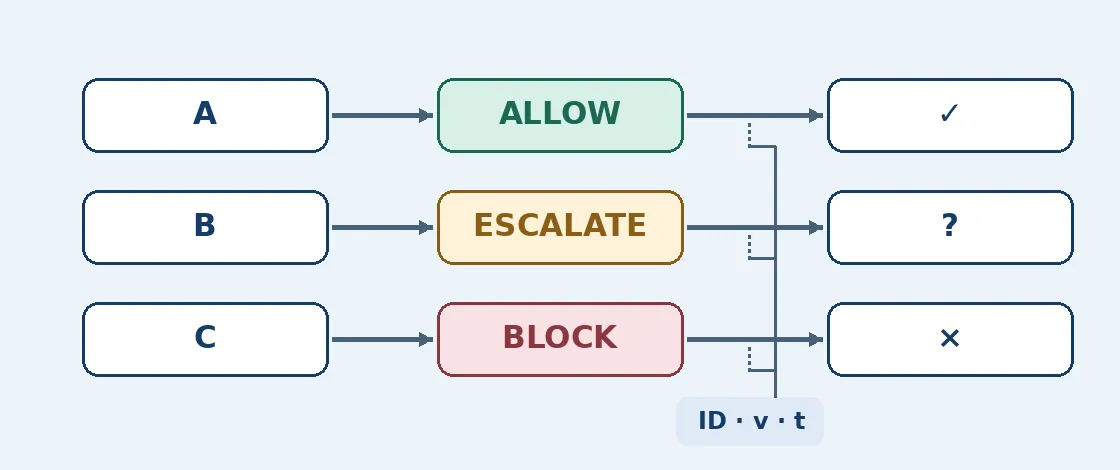
Original acceptance diagram, not a product screenshot: allow A, escalate B, and block C. All three should map to the same evidence fields: request ID, policy version v and time t.
Check what actually happened
Give someone the gate records and stub ledger to reconstruct each outcome. Keep the decision record distinct from the action record: B while waiting and C after denial must show no action, and an approved action must match its request. Missing fields, execution during waiting or an unexplained outcome stop the proof of concept. A single test does not establish certification, service levels or production fit.
When to continue
One fixed workflow may be easier to maintain with a local allowlist and manual approval. If several teams need consistent review and evidence, compare Aegisora with existing access and approval controls. Name policy and approval owners and document evidence retention and how to end the pilot. Do not connect production without repeatable records and clear owners.
Content note:This article is based on publicly available information and is intended as a reference for evaluating tools. Features, pricing, and related policies may change at any time; please refer to the latest official information.
Original source:github.com