Choose AiHouse for cabinet proposals only if accessory quantities still reconcile after a combination changes
Custom-furniture teams considering AiHouse should first verify codes and accessory quantities after editing a combination. A once-per-order manual can be consolidated, but physical parts must not all be deduplicated. Include library upkeep, handoff checks and the actual module costs in the decision.
For a custom-furniture team choosing AiHouse, the useful first test is not another attractive render. It is whether design data and the handoff list remain consistent after a cabinet combination changes. If every addition or combination change means ungrouping assets, rebuilding information and manually removing duplicate accessories, the product has specific capabilities worth validating. If you only draw an occasional space and have no maintainable product codes, migrating a whole workflow just for rendering may not pay off.
AiHouse’s official feature description places two capabilities within its custom-design workflow. Cabinet combination editing allows parameter and basic-information changes, plus adding units and standard products without ungrouping. Accessory output management can consolidate specified-code accessories needed only once per order onto the first unit, with a merged quantity of 1. The official example is an installation manual. It does not justify deduplicating every hinge, connector or other part counted by actual consumption. The documentation does not specify how multiple independent combinations are consolidated across an entire order, so do not assume that they also produce just one copy between them. The first capability reduces the need to break apart assets when editing; the second handles a defined output rule. Neither follows merely from a model looking good.
Use three units in one combination to separate “one per order” from “two per cabinet”
Use a self-created synthetic order with no customer information for acceptance testing. Suppose each of three cabinet units within one combination includes one same-code manual M and needs two same-code hinges H. The business has specified that this order needs only one manual. The expected output is M consolidated from 3 copies to 1, while H remains 2+2+2=6, not every same-code item reduced to 1. M and H are identifiers defined for this example, not built-in software codes, and two hinges is not an installation prescription for a real cabinet.
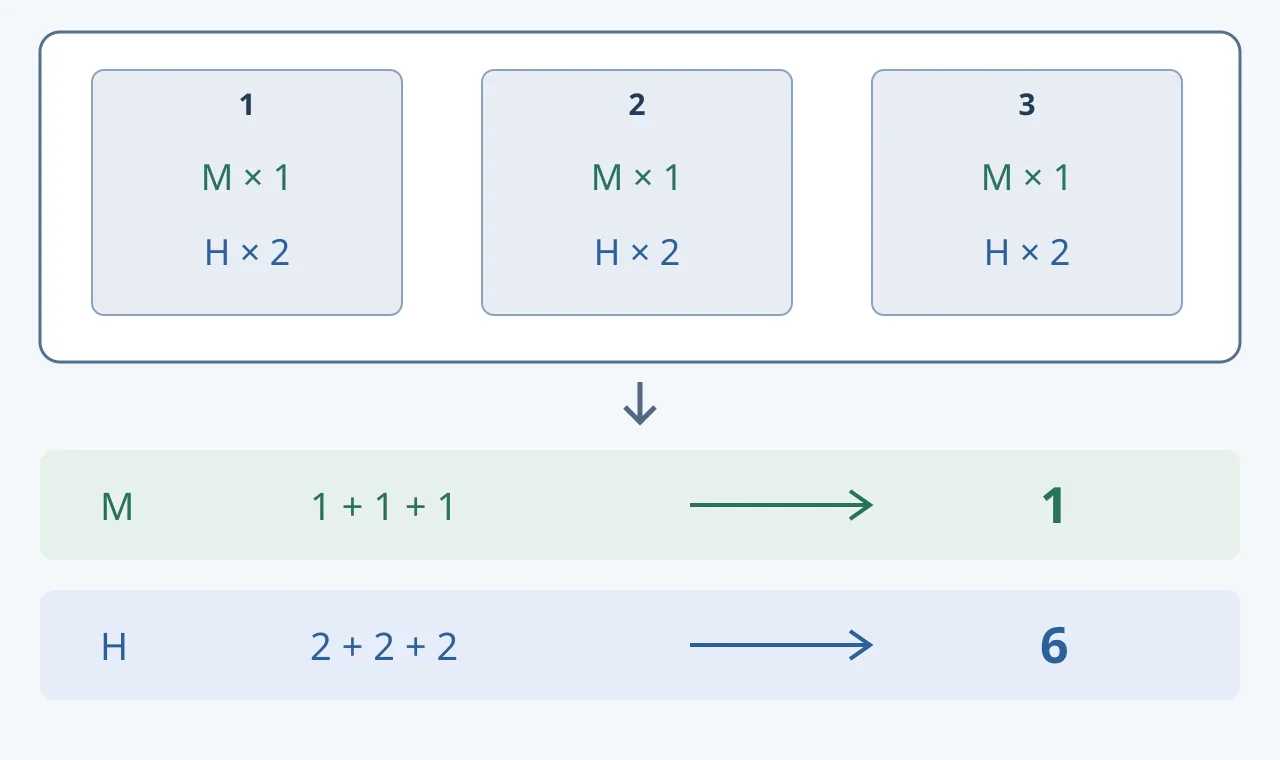
Original hypothetical example, not the AiHouse interface or a measured test. The large frame contains three cabinet units in one combination. M is a same-code manual the business requires once per order; H is a same-code hinge counted as two per unit in this example. Only M follows the consolidate-to-1 rule; H stays at 6. Codes and quantities are teaching assumptions, not built-in values or installation advice. Do not infer consolidation across separate combinations.
In the pilot, have a designer edit the combination, then add a fourth cabinet unit with the same rules within that combination and recheck the output. In this hypothetical case, the manual should stay at 1 and hinges rise from 6 to 8; their originating units should also remain traceable. If only the image changes while the list retains old counts, or required physical quantities also collapse to 1, do not place a purchase order on that basis. This is a proposed acceptance method, not a test result from our use of the software. Check parameters, code mappings and output together, not just a consolidation switch.
Pay for a maintainable handoff, not for dispensing with checks
AiHouse’s description supports trying to maintain proposals with less ungrouping. It does not establish automatic compatibility with your existing product library, quotations or production system. Ask the supplier to demonstrate a complete handoff using your synthetic rules, identify required modules and account permissions, and confirm which list fields or output files it can actually supply. Then check whether the receiving process recognises codes, units and quantities. Budget any integration not proven to work as still requiring manual conversion. A design file is not a guarantee of direct manufacture or construction.
Compare the same proposal and one cabinet addition before and after adoption, recording total time for asset preparation, parameter changes, code checks, export preparation and handoff review. Include initial library cleanup, staff learning and ongoing rule maintenance, and compare with keeping the original design tool plus a manual list. If the same expert still has to reconstruct all quantities in a spreadsheet every time, the software merely adds an earlier step. Before buying, request a written quote covering actual modules, seats and output requirements rather than comparing only a promotional entry price.
AiHouse is more suitable for routine design handoff in this kind of team only when, after combination changes, someone can still explain why each quantity was retained or consolidated, and the entire workflow genuinely reduces repeated entry and rework. Consolidating installation manuals is a small but useful test of product codes, counting rules and post-change checks at once. If nobody owns those rules yet, first organise one verifiable sample with existing tools rather than migrating every project immediately.
Content note:This article is based on publicly available information and is intended as a reference for evaluating tools. Features, pricing, and related policies may change at any time; please refer to the latest official information.
Original source:aihouse.com