airfocus: Two ideas average 3. Why discuss one separately?
Use disagreement, not the average alone, to decide when Priority Poker is worth it.
airfocus’s 2025 Priority Poker introduction describes individual scores followed by discussion. Consider it if the first speaker tends to anchor the room and disagreement needs unpacking. If order follows agreed deadlines or dependencies, start with a list. If people interpret the scoring framework the same way, you need not vote on every item.
Equal averages are not agreement
Give four fictional reviewers one rule: 1 means little work saved; 5 means substantial savings. A, offline export, gets 1, 1, 5, 5. B, saved filters, gets 3, 3, 3, 3. Both average 3; the ranges are 4 and 0. Use an example trigger of a range of at least 3 to ask why. If A’s high votes count weekly savings and low votes count only first use, align the time window and score independently again. Do not rank from the first pass.
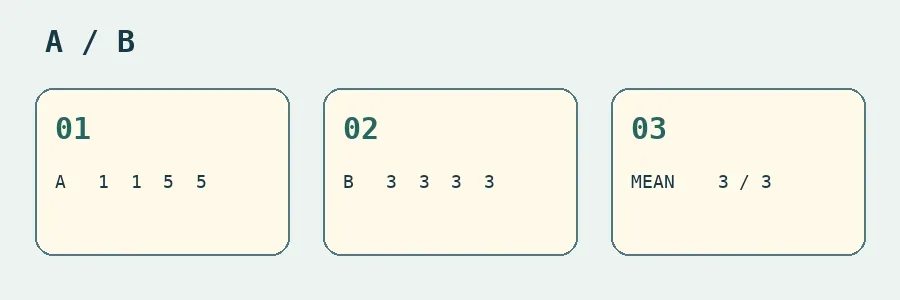
Original comparison, not the product interface. The same average hides a split worth investigating in A.
Include evidence follow-up in the cost
Compare preparation, discussion and evidence follow-up against a plain spreadsheet. Record whether the gap came from definitions or evidence, who will check, and when to revisit. If A still lacks usage-frequency evidence, do a small discovery exercise, not development approval by average. Adopt if the disagreement recurs and two rounds leave a clearer decision record. Do not score employee performance.
Content note:This article is based on publicly available information and is intended as a reference for evaluating tools. Features, pricing, and related policies may change at any time; please refer to the latest official information.
Original source:airfocus.com