Is Aiwo worth buying? Check billing contacts per thousand bills before celebrating a lower total
Aiwo is worth evaluating when contact causes across channels need to reach the people who can fix the process. Check the original statements, billing volumes and ownership together; a lower contact total is not proof of improvement. For smaller problems, first compare the cost of existing sample reviews and reports.
Resolving a customer's problem after answering their call does not mean they needed to make that call in the first place. For teams facing recurring billing questions that involve both customer service and billing, Aiwo is worth evaluating for its ability to connect contact reasons, business volumes, handling costs and the people responsible for fixing processes, rather than how many agents it can replace. If a small monthly set of similar tickets can already be understood through manual sampling and existing reports, another analytics platform may be unnecessary.
Aiwo's official Customer Contact Intelligence description combines customer conversations with operational data, analyzes contact reasons in connected channels, and links issues with costs and business owners. Its product introduction also describes role-specific reporting and an API for exporting analytical reports to BI platforms. These are vendor descriptions, not guarantees that every system connects in one step or that the analysis establishes accurate causality. It is better considered an analytics layer alongside existing service systems. If the immediate need is faster replies, these analytical capabilities alone do not establish whether it will meet that need.
Separate billing causes before deciding who should change what
Start with fictional billing inquiries to test the analysis path. “I don't know when payment will be taken,” “I was charged twice for the same item,” and “The bill went to the wrong address” all concern billing, but point to wording, a payment anomaly and an address process respectively. Putting them in one broad category produces little more than an attractive share-of-contacts chart. Ask for a demonstration that preserves the mapping from original statements to detailed reasons, have customer service and billing colleagues review it together, then assign an owner to each actionable issue. A duplicate charge needs investigation and correction, not discouraging customers from contacting you because it increases the contact count.
This distinction reflects what Aiwo calls failure demand: additional contacts generated when a service or process fails to meet a need the first time. Its article on NPS notes that customers may be happy with how an agent resolved their problem while the same process continues to generate requests for help. That perspective is useful, but “avoidable contact” remains a judgment to check, not an instruction to delete a ticket once a model labels it. Before connecting real data, also ask how missing channels, failed transcriptions and unclassified records are shown. Data outside the analysis cannot be treated as zero problems.
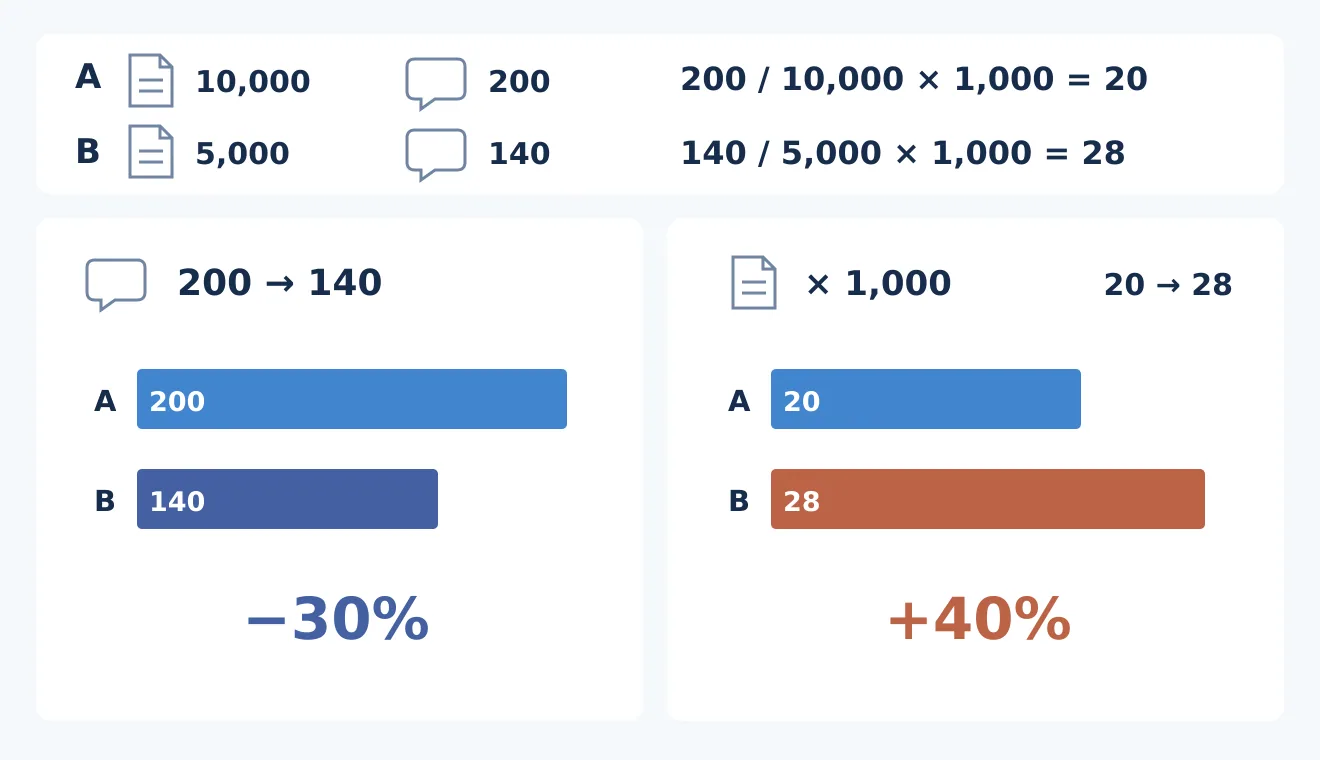
Original acceptance-test example, not an Aiwo interface or measured result. Both periods use the same contact definition, channels and post-billing observation window. The left panel shows total contacts; the right shows contacts per thousand bills. Both total contacts and the number of bills fell, but the number of bills fell more, so fewer contacts alone do not establish a process improvement.
Fewer contacts can still mean a worse rate per unit of business
Suppose two comparable billing periods use the same-length observation window after bills are issued, the same channels and the same definition of a billing contact. Period one has 10,000 bills and 200 contacts; period two has just 5,000 bills and 140 contacts. Total contacts fall by 30%, but contacts per thousand bills rise from 20 to 28, an increase of 40%. The lower total cannot simply be recorded as a successful bill redesign. This is a hypothetical acceptance question for selecting analytics tools, not an Aiwo customer result, nor a claim that Aiwo automatically selects the right denominator.
A demonstration therefore needs more than reason categories: business colleagues must also verify the bill volumes for the relevant periods, observation windows and channel coverage. One issue can generate several contacts, and contact counts are not counts of affected customers. A before-and-after comparison must also consider customer mix, other process changes and missing data. Even a lower contact rate does not, on its own, establish that the redesign caused an improvement. Ask to preserve these definitions in exportable reports or existing BI, rather than presenting only a downward curve.
The purchase decision should rest on an improvement someone can take responsibility for: clarify the payment-date wording, for example, have the billing owner implement it, then track related contacts on a consistent basis and check whether the issue has merely moved to another channel. First compare the labor required to do this with existing sampling and reports, then examine Aiwo's written quote and the costs of the required channel connections, report exports, review and ongoing maintenance. Whether analytical time savings and supported business improvements cover the added cost matters more than a vendor's headline savings percentage. If owners will not act on the issues discovered, greater analytical detail is unlikely to produce a return.
Use only synthetic conversations and fictional business volumes in the initial demonstration, with no real customer bills, recordings or account information. Before a real pilot, the organization should confirm the lawful scope of use, minimum necessary fields, retention period and access permissions. Broaden the evaluation only when detailed causes can be traced, denominators and missing data explained, and a business owner can take over. Otherwise, improve definitions and collaboration in existing systems first; fewer calls are not a substitute for solving the problem.
Content note:This article is based on publicly available information and is intended as a reference for evaluating tools. Features, pricing, and related policies may change at any time; please refer to the latest official information.
Original source:www.aiwo.ai