Alibaba Cloud PAI-EAS buying guide: reserve inference capacity or burst into an elastic pool?
Compare public resources, a dedicated baseline, and elastic overflow in PAI-EAS. Check placement constraints first, distinguish target replicas from ready capacity, and include the opening minutes of the peak and the full cost of occupancy in your buying decision.
If your team already has a working model and needs a place to serve online inference, Alibaba Cloud PAI-EAS belongs on the shortlist. You are buying compute and service management for your model, not an allowance for calling a ready-made chat model. The deciding questions are how much capacity to keep in quiet periods, whether new replicas can take requests in time during a spike, and where those replicas are allowed to run.
PAI-EAS is the inference deployment component of Alibaba Cloud PAI. Alibaba offers public resources, dedicated resource groups, and other deployment options. Public resources are available on demand with pay-as-you-go billing and no advance purchase of dedicated resources, but sufficient supply is not guaranteed at busy times. Dedicated resource groups must be purchased first and provide exclusive compute through subscription or pay-as-you-go billing. “Public” here describes shared compute. It does not mean the service is necessarily exposed to the public internet or that workloads may cross existing placement boundaries.
Decide which requests really need an immediate response
If you only need a small-scale model validation and waiting for capacity will not harm the business, compare public resources first. If you have steady daily traffic or your organization requires dedicated deployment, estimate a dedicated baseline first. For occasional spikes, the EAS elastic resource pool can draw on pay-as-you-go public resources when your own capacity is insufficient, then release instances on public resources first when scaling in. That scheduling policy does not guarantee supply. For work that can wait overnight, compare batch processing or scheduling rather than maintaining an online endpoint with no immediate response requirement.
Imagine a service using the same model and replica specification throughout: the normal target is two replicas, the peak requires six, and the target then returns to two. The plan retains two dedicated replicas and requests four public replicas at peak. Six in the figure is a capacity target. The four hatched replicas are the capacity you want to add, not capacity already allocated, and certainly not proof that the model has loaded and can respond correctly. That distinction determines whether the elastic pool can replace capacity held ready in advance.
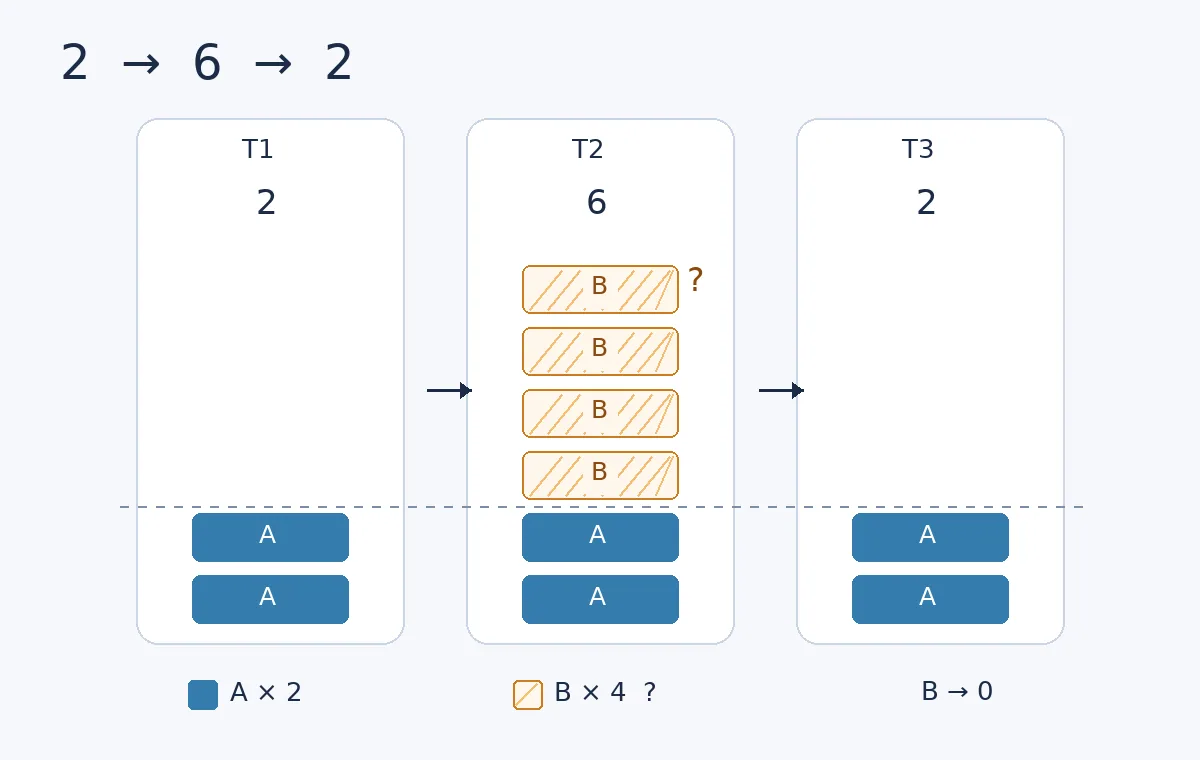
Original diagram of capacity targets, not an Alibaba Cloud interface or load-test result. T1, T2, and T3 are the quiet period, peak, and return to baseline, not intervals of equal duration. A marks the two dedicated baseline replicas. B marks the four public replicas wanted for the peak. Hatching and the question mark mean the diagram cannot establish that they have been allocated or are ready. As demand falls, public instances are released first. Each block represents one hypothetical service replica of the same specification, not a machine purchased, a throughput guarantee, or a billing rate.
In this example, four extra replicas of the same specification, each lasting half an hour, amount to two replica-hours for comparing usage. That is neither two machines nor an Alibaba Cloud quote or universal billing unit. The dedicated baseline still costs money, and the actual bill depends on the region, resource specification, billing method, and applicable extras. If model loading or the wait for release extends occupancy, do not estimate the bill from just the half-hour traffic spike. Compare the total cost of a dedicated baseline plus actual overflow with reserving peak capacity in advance, against the same service objective, rather than comparing only the extra replica unit price.
Check the first minutes of the peak, not just the daily average
Before buying, list the model files, runtime, and authorized dependencies. A model that works in one environment may not work with your selected CPU or GPU specification, drivers, and memory. Check available resources in the target region and whether elastic replicas can fetch the files they need within the permitted access boundary. If the organization does not allow this workload to run on shared resources, leave the elastic pool out of the cost comparison. Do not change network or security restrictions just to make a demo pass.
In a separately approved test environment, use synthetic inputs to replay a quiet period, sudden spike, and return to baseline. Keep the model version, input mix, and output acceptance rules fixed. EAS provides stress testing and monitoring, but the business should set the acceptance criteria. Record replicas requested, replicas ready to take requests, and the latency, failures, and output correctness users actually see. Report the first minutes of the peak separately and count queuing and retries. A low daily average can hide the scaling gap that matters most. This is a proposed acceptance test, not a report of a deployed service or a cloud load test.
Check what happens after demand falls. Record whether public instances are released first, whether the remaining dedicated replicas still handle ordinary requests, and whether in-flight requests finish. If public capacity fails to arrive on time, decide whether the business can wait, deprioritize nonurgent work, or must reserve capacity. Assuming autoscaling will happen is not a recovery plan. The people responsible for the model, the budget, and approving placement should all be able to see the same trade-off in that record.
Buy based on capacity you can deliver
Choose public resources for small validations that tolerate supply swings. Choose dedicated resources for a steady baseline or explicit isolation requirements. Add an elastic pool only if shared placement is approved, peaks really are infrequent, and measured readiness and tail latency pass. Tail latency is the waiting time for the slower share of requests, not something the average can stand in for. Keep a quote based on comparable conditions, an acceptance record covering scale-out and the return to baseline, and a plan for when extra capacity does not arrive. If any of those is missing, retain approved, predictable capacity rather than lowering the baseline just because autoscaling is available.
Content note:This article is based on publicly available information and is intended as a reference for evaluating tools. Features, pricing, and related policies may change at any time; please refer to the latest official information.
Original source:www.alibabacloud.com