alwaysAI buying guide: why the right carton total can still fail an inventory check
Use a synthetic example where one missed carton and one duplicate cancel out to evaluate an alwaysAI freight tracking project. Separate detection from event tracking, verify target-device conditions, and include exception review and maintenance in the purchase cost.
If a warehouse needs to know precisely how many cartons crossed a passage, boxes around cartons in a demo do not establish whether alwaysAI is worth buying. The deliverable should be a movement log the team can reconcile: a carton that stays visible across frames is counted once, a temporarily hidden carton does not become a new one, and a missed carton cannot be offset by a duplicate elsewhere. If barcode scans already cover the passage reliably, retain them as a baseline instead of replacing them because a vision demo is easier to see.
alwaysAI's logistics offering explicitly lists pallet and inventory tracking and tracking for arrival, delivery, and dispatch. Its platform spans data labeling, model training, application deployment, and analytics. The team can develop an application or commission customization from the vendor's engineers. This is a vision application project that needs acceptance testing and maintenance, not a general object detection template that can stand in for a warehouse ledger. This guide discusses synthetic cartons without people, not person identification, surveillance, performance evaluation, or safety enforcement.
Turn “the object was visible” into a defined operational event
The vendor's object detection documentation describes output as an object class and a bounding box. Its tracking guide discusses retaining the same object's identity across frames and identifies occlusion, background clutter, and frame-rate differences as challenges. Define what the project should count first: the cartons visible in an area now, or a crossing in a specified direction? The guide uses the latter. If a carton stops in the passage, backs out, and enters again, your operational rule decides whether that is a new event, not the number of detection boxes.
Start with a synthetic animation containing no real customer details, shipping labels, or people. Give the six cartons identities A through F that the editor knows in advance. Each crosses once in the specified direction, so the correct event list is A, B, C, D, E, F. If the system leaves A, B, C, C, E, F, the total is still 6, but D is missing and C is counted twice. The total passes only the broadest check. It does not prove the item-level log can reconcile inventory. The letters are ground truth for acceptance, not evidence alwaysAI reads labels automatically or identifies individual products.
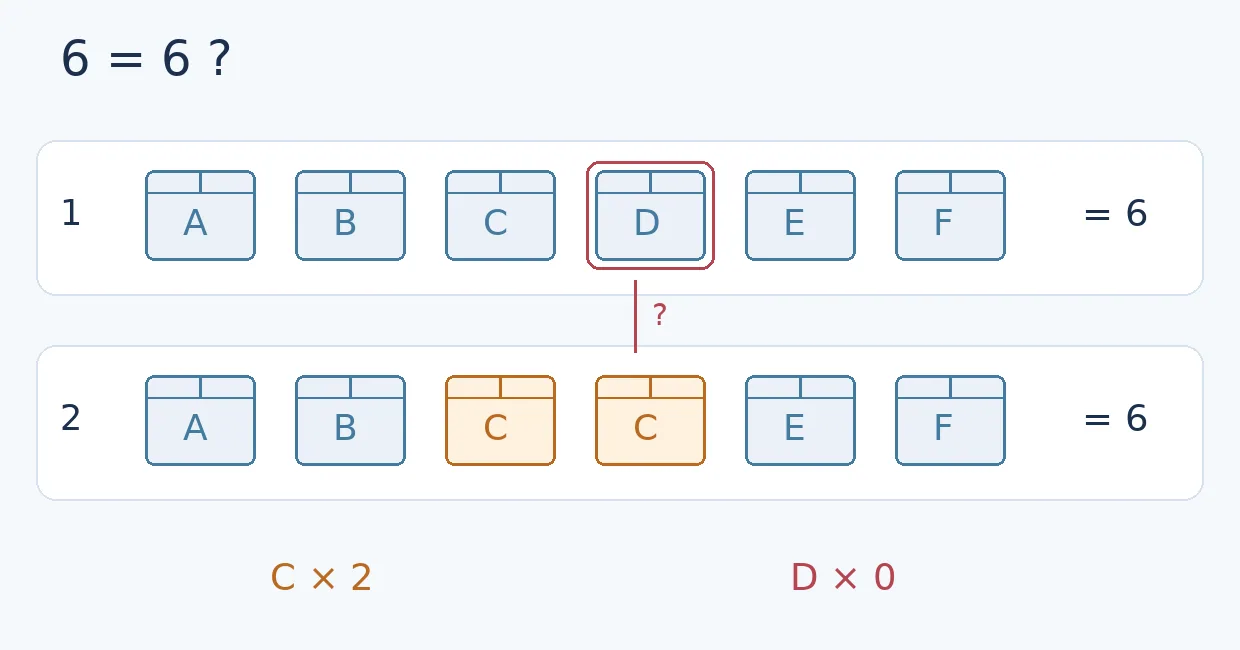
Original synthetic event log, not an alwaysAI interface or test result. Row 1 contains six carton crossings defined in advance by the editor. Row 2 is hypothetical output: C is recorded twice and D is absent. Both total 6, yet only five expected events matched, with one duplicate and one omission. The letters are acceptance-test ground truth, not a claim that the product can read barcodes or identify goods automatically. They do not establish product accuracy.
In this example, only five of the six expected events matched, with one duplicate and one missing event. Do not present that as alwaysAI's accuracy or use six examples to settle the purchase. Instead, use it to design the acceptance sheet: record the difference in totals, the match for each expected event, unmatched records, and manual review time. When actual goods look very similar, preparing reliable ground truth may itself take work. If you cannot establish the correct answer, impressive detection boxes have nothing reliable to compare against.
Test the same sequence under target-device conditions
The alwaysAI tracking guide specifically warns against carrying laptop prototype results straight over to edge devices. Cameras and actual processing frame rates can differ. Build controlled variation into the synthetic clip: single cartons, side-by-side cartons, short occlusion, a pause, and a return. Validate it under planned deployment conditions in an authorized test environment. A frame being visible does not mean every frame will be processed during inference. If throughput lags, even correct detection on isolated frames can miss a transition between events. Do not use a demo computer to promise the same outcome on different equipment.
When scoping with the vendor, ask about input conditions, record format, and exception handling separately: permitted image dimensions, viewpoints and processing rates; whether records can include verifiable timestamps and event identifiers; and how uncertain entries after an occlusion or interruption reach a human reviewer. These are requirements to demonstrate and write into the project scope, not features this guide claims are in every package. Compare test outputs with an offline sample ledger first. They should not automatically change inventory, start shipping, or operate site equipment.
Synthetic material is useful for checking counting rules, duplicate handling, and the acceptance sheet. It cannot prove the outcome with a real camera. If the team cannot explain even this controlled case, do not widen the scope. A pass only supports a separately authorized site-fit assessment, not going straight into production. Keep barcode scanning or manual review as a benchmark and fallback. Leave uncertain records for checking rather than automatically filling in a number to make the report look complete.
Quote for exceptions, not just normal footage
Ask for a quote for the same passage and acceptance criteria and name who handles data preparation and labeling, model adjustments, target devices and camera fit, record integration, and review and maintenance after launch. A vendor's ability to customize does not put these items into an unverified fixed price. Compare the cost of existing scanning plus exception review with that of the vision project plus retained scanning, review, and maintenance. That compares ways of buying the same outcome.
Suppose review takes 40 minutes a day today. Vision assistance brings routine checks down to 15 minutes, but matching exceptions takes 20 more. The net saving is just 5 minutes, not 25, before initial setup, hardware, or ongoing expenses. This illustrates what to count, not a product test. If duplicates and misses cancel out, review backlogs accumulate, or adding a new freight type requires adjustments beyond the budget, narrow the scope or keep the original scanning workflow.
alwaysAI belongs on the shortlist when the team really needs to turn movement across frames into auditable events, barcode scanning leaves a known gap, and there are resources for labeling, hardware fit, and ongoing review. If you only occasionally want to count cartons in a photo, or cannot define a crossing, establish ground truth, or name an exception owner, an integrated vision platform may add more burden than value. Keep item-level acceptance records, a comparable quote, and a fallback plan before widening deployment. A matching total by itself is not a reason to approve the purchase.
Content note:This article is based on publicly available information and is intended as a reference for evaluating tools. Features, pricing, and related policies may change at any time; please refer to the latest official information.
Original source:web.archive.org