Amplitude: If every event arrived, why did the funnel count only one conversion?
Use three toy event sequences to separate unique entrants, event counts, order and conversion window.
Amplitude’s 2023 release already described Funnel Analysis. Its docs distinguish unique users from event totals and ordered from any-order paths. Use a funnel to compare conversion for a consistent journey. For clicks, retries or noisy instrumentation, use event counts. Do not change the definition just to make those totals match.
Reconcile three event sequences
On paper use fictional IDs A, B and C, with no real tracking. Define Start then Finish in 24 hours. A starts twice and finishes once that day. B finishes then starts and never finishes again. C finishes after 25 hours. With all starts in the reporting range, this is one of three entrants, about 33.3%, not three finishes divided by four starts. An any-order comparison can isolate B; do not change other settings or pull C into a 24-hour window.
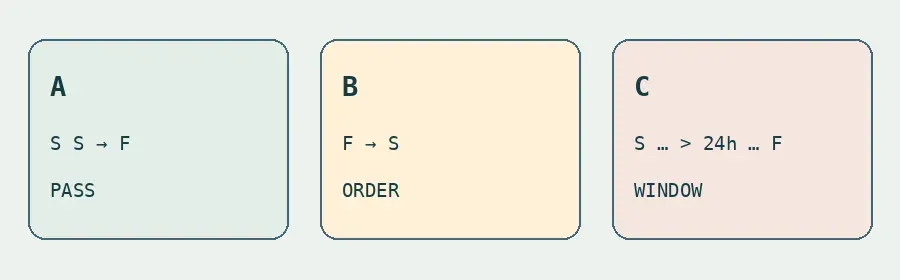
Original event schematic, not the product interface. Only A passes the ordered 24-hour example.
Write down the whole definition
Record entry event, unique ID, order, window and date range together. If there are intermediate events, distinguish ‘this order’ from ‘exact order,’ which excludes events in between. A reviewer should explain who converted and why. If the toy example fails, check event meanings and timing first. Keep a raw-event reference if the funnel needs manual explanation every time.
Content note:This article is based on publicly available information and is intended as a reference for evaluating tools. Features, pricing, and related policies may change at any time; please refer to the latest official information.
Original source:amplitude.com