Choosing AnyCap: two observations from split recordings may be one issue
AnyCap lets a coding agent analyze your own recordings, but local files are uploaded and segmentation adds requests and manual reconciliation. Adoption should depend on preserving original timestamps and separating duplicate observations from distinct events. For a few short recordings or judgments needing the full context, manual review may be better.
A product team gives a coding agent its own demonstration recording, hoping to identify moments worth a human review before deciding whether documentation needs changing. AnyCap’s value is connecting video understanding to the agent, not replacing the person responsible for accepting software behavior. If a team can already watch a few short recordings and note issues directly, another runtime, upload step and reconciliation process may not pay off.
AnyCap’s official CLI documentation defines video-read as an action that reads one video and returns text in response to a question. It accepts one video URL or one local file, with instruction available to focus the observation. Local files are uploaded automatically; the documentation requires them to be under 100 MB. “Local” describes where the file starts, not where the model analyzes it. Evaluation should use self-created recordings of a fictional application approved for external processing, without customer data, keys, personal conversations or unauthorized windows.
A successful upload clears only the first hurdle
The official guidance favors keeping the complete video and considering compression first. With persistent upload failures, segmentation is suitable only when the task is safe to analyze in parts. Its reference ranges are 2–5 minutes per segment, 2–5 seconds of overlap and at most 2–3 concurrent requests. It explicitly excludes tasks depending on whole-video narrative, cross-segment causality or continuous identity tracking. This article concerns fictional interface events without people, not identity tracking.
Compression must preserve the evidence the question needs. If the task asks whether a notification appeared after a transition, a person should verify that its text and timing remain recognizable after compression, not just that the file is below the size threshold. Otherwise, keep the original for manual review or narrow the question. “Not visible” in a low-quality copy must not become “did not happen” in the original. These are pre-adoption acceptance requirements, not measured AnyCap accuracy.
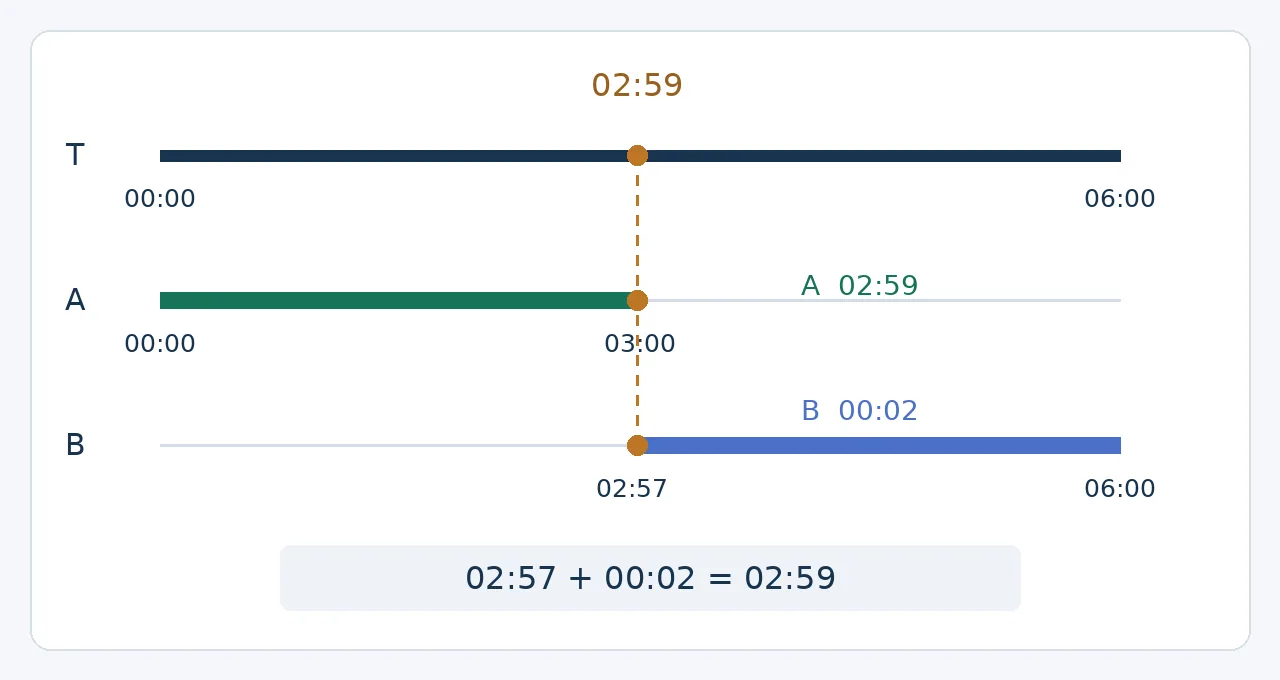
Original hypothetical diagram, not the AnyCap interface or a test result. T is the 6-minute original; A covers 00:00–03:00 and B covers 02:57–06:00, overlapping for 3 seconds. The vertical dashed line aligns one event at original time 02:59: 02:59 within A and 00:02 within B. B’s start 02:57 plus 00:02 gives original time 02:59. Verify against the recording before deduplicating; two returned entries do not automatically mean two failures.
Suppose a 6-minute recording is split into A at 00:00–03:00 and B at 02:57–06:00. A notification at original time 02:59 may appear as 02:59 in A’s results and 00:02 in B’s. Adding B’s start offset of 02:57 returns the latter to original time 02:59. They are two candidate observations of one event, not automatically two failures. Overlap preserves boundary context but creates a manual deduplication responsibility. All times in the diagram are hypothetical; no real analysis was run.
The table handed to a colleague should retain at least the source recording version, segment start, within-segment time, converted original time, observation and human confirmation status. Nearby timestamps alone are not enough to merge entries: if two notifications really occur, keep both. If the model gives different interpretations of one notification, review the source before deciding. Entries with no matching visual evidence should remain unconfirmed rather than become established defects.
Segment count changes cost, not just speed
video-read accepts one video per invocation. Parallel segmented analysis is multiple agent-orchestrated requests, not one batch call. The official documentation warns that each segment may use its own credits and rate-limit capacity. The example changes one whole-video request into two segment requests; running both segments again makes four requests, not one because they share a source recording. Before adoption, obtain explicit pricing and failure-billing rules for the chosen capability, then compare whole-video, segmented and manual review. Do not turn a current advertised unit price into a fixed long-term assumption.
Include reconciliation time too. Suppose watching and documenting the original manually takes 12 minutes. With agent assistance, a person spends 3 minutes preparing, 4 checking timestamps and 3 merging duplicate results. Net saving is 12−(3+4+3)=2 minutes, not all 12 minutes. Model waiting time, actual fees and integration maintenance are additional considerations. This is not a measured return. If preparation and checking already exceed the original 12 minutes, more concurrency will not fix the economics.
AnyCap’s returned text can form a list of observations awaiting verification. A success status does not establish that an observation is correct, and should not authorize the agent to modify production systems, send incident notifications or publish a report. Keep request identifiers to diagnose technical problems and reserve external actions for explicit human approval. If the only question is what was said and an approved transcript already exists, first consider whether uploading the video is needed at all.
A suitable team can locate every observation in its own sample’s original timeline, handle boundary duplicates correctly and demonstrate net labor savings under the same complete-delivery standard. If files may not leave the organization, compression makes critical text unreadable or the judgment needs the full causal context, do not force adoption by repeatedly splitting clips. Preserve a verified evidence trail, not just a longer AI-generated issue list.
Content note:This article is based on publicly available information and is intended as a reference for evaluating tools. Features, pricing, and related policies may change at any time; please refer to the latest official information.
Original source:github.com