Choosing AppUFO: preserved placeholders still need meaning and layout checks
AppUFO can reduce first-pass .xcstrings translation and file handling, but a character limit does not constrain expanded text and back-translation does not guarantee the intended action. It suits Mac developers who can review target-language meaning and interfaces. Decide on payment using net time saved across delivery and the AI usage rules.
When adding languages to your own iOS app, the hard work is often not translating sentences but returning them to engineering with buttons, variables and intended actions all intact. AppUFO suits Mac developers who already use an .xcstrings string catalog and can arrange target-language review. It can reduce initial translation and file handoffs. For just a few fixed phrases, or without anyone able to judge whether a translation changes the action, maintaining the existing catalog manually is usually more controllable.
AppUFO’s website describes importing .xcstrings, translating with application context and exporting back to Xcode. It also offers placeholder preservation, per-phrase character limits, a glossary or words kept untranslated, and reverse translation using Apple Translate. These address structure, length, terminology and preliminary checking respectively, but the website’s UI-fit marketing cannot replace acceptance checks in the actual interface. What follows is procurement analysis using invented strings, not a measurement of AppUFO’s translation accuracy.
Separate removing a favorite from deleting a file
Imagine a fictional file-favorites app with a button labeled Remove %@. It only removes a file from favorites; it does not delete the file. Translation context must explain this distinction. The French Suppr. %@ retains the variable and is short, but can suggest deletion. Retirer %@ is closer to the intended removal here, and still needs a target-language reviewer to confirm it in its page context. A glossary can fix a product name, but cannot by itself decide what this button does.
Back-translation helps identify wording worth questioning, not provide the sole certificate of acceptance. Two different French phrases might both return the broad English word remove. Similarity to the source does not prove that readers of the target language understand the same action. For state-changing copy, ask the reviewer to explain what remains and what disappears after a click, then compare that with the developer’s intent. Without this review capability, adding languages adds risk the team cannot assess.
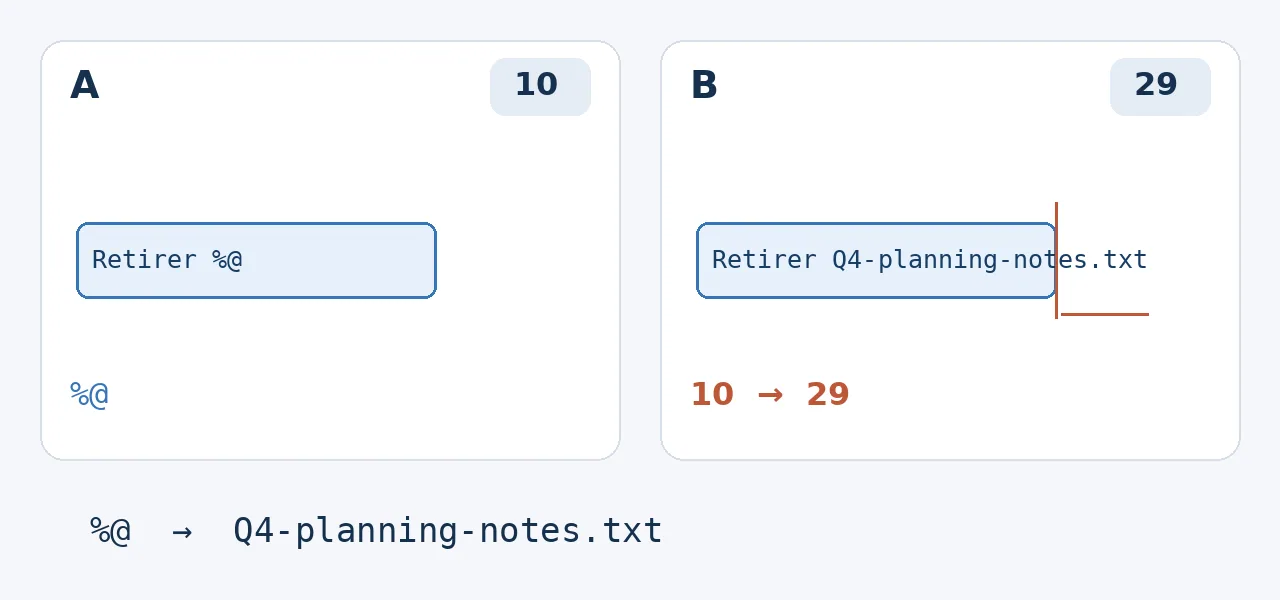
Original illustration: A is the French template Retirer %@, including %@, with 10 characters. B substitutes the invented filename Q4-planning-notes.txt, producing 29 characters. The boxes have equal width; the orange line marks B’s overflow. This explains template limits versus runtime layout, not a product screenshot or an actual test.
Character limits have another boundary. Retirer %@ contains 10 characters including the space and placeholder. Replacing %@ at runtime with the fictional filename Q4-planning-notes.txt produces a 29-character label. A template meeting a 10-character limit does not establish that the expanded button text fits. Display width also varies by font, size and language, so character count is not an adequate substitute. The diagram’s fixed width only illustrates this relationship; it is not an AppUFO or iOS interface.
Before adoption, keep a copy of your own catalog and choose a small set of revealing strings: a fixed short phrase, an action containing a variable, a long fictional variable value and wording that could turn removal into deletion. After export, compare keys, source text and placeholders with expectations, then separately check target-language meaning and the expanded layout. Passing structural checks leaves meaning and layout to be decided independently. If a phrase fails, revise and recheck the affected content; do not send a successfully exported file straight to release. These are acceptance requirements, not claims that the tool performs the checks automatically.
Separate AI allowances from the cost of completed review
The website lists AI-inclusive plans at €9.99 monthly with 25,000 AI phrases and €69.99 yearly with 250,000 AI phrases. The one-time €39.99 Lifetime option requires your own AI key; prices may vary by region. The page does not clearly map one phrase of usage to target languages, retries after failure or retranslations. Do not treat source strings multiplied by languages as a definite bill. Confirm usage calculation and replenishment before purchase, and do not assume the annual allowance is twelve times the monthly allowance.
For an AI-inclusive subscription, check total spending and whether the allowance covers expected revisions. For your own key, include model-provider charges and responsibility for credential management. €39.99 is not the total cost of all future translations. Bringing a key also does not automatically mean offline processing or remove the need to examine data flows. Evaluation files should contain only self-owned fictional copy approved for external processing, without real user names, customer material or secrets. If organizational data-processing requirements cannot be met, stay with an approved manual process.
Do not remove the shared costs of target-language review and interface acceptance from the comparison. Suppose manual translation and acceptance for the same batch take 90 minutes. With assistance, context preparation takes 15 minutes, translation revision 30 and export plus interface checks 35. Net saving is only 90−(15+30+35)=10 minutes, with software and model fees additional. This is an illustration, not product speed data. If repeated repairs to variables or meaning consume those 10 minutes, fast generation has not met this purchase objective.
Adoption is worthwhile when the same strings can round-trip through the catalog intact, target-language review confirms the intended action, long variables remain usable in the target interface, and the complete process saves time against the existing manual workflow. Many generated languages, similar-looking back-translations or compliant template lengths cannot individually justify a purchase. Preserve each button’s behavior before deciding to hand more languages to AppUFO.
Content note:This article is based on publicly available information and is intended as a reference for evaluating tools. Features, pricing, and related policies may change at any time; please refer to the latest official information.
Original source:appufo.app