Is an ApX course worth taking? Check time leakage with six weeks of data
Use fictional checkout counts to test whether the course teaches chronological splits, known inputs and a baseline.
Choose a course that exposes mistakes
ApX’s September 2025 course article corroborates the platform’s ML course offering. Its time-series split chapter explains how shuffling can expose a model to the future. If you know basic Python but not forecast evaluation, read that chapter before committing to the whole track.
Try one six-week paper exercise
An imaginary library records 18, 20, 19, 22, 24 and 23 checkouts. Predict week 5 from what is known in weeks 1–4; do not train on week 6 to judge week 5. Use week 4’s 22 as the naive forecast for week 5. Actual 24 means absolute error 2. Move the clock forward separately for a week 6 forecast. Do not tune the rule after viewing both test weeks. Use synthetic numbers only.
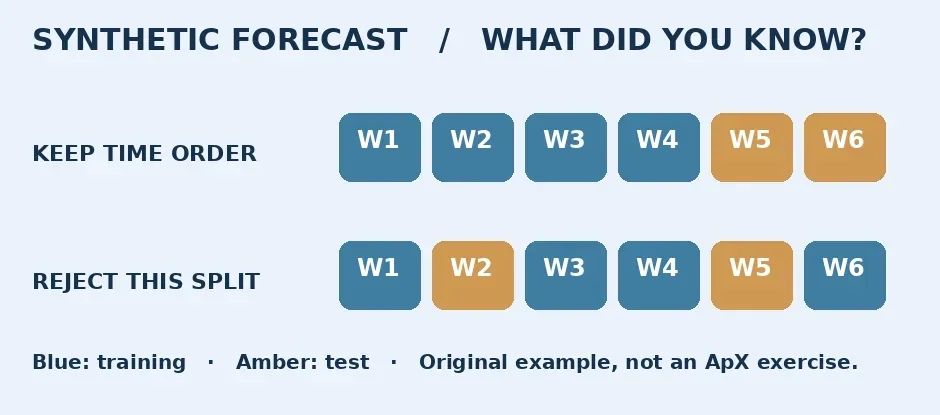
Original teaching check, not an ApX exercise or a measured result.
Explain when each input exists
Ask a second learner why not to shuffle weeks, why the end-of-week count cannot predict that same week, and why an error of 2 is not long-run performance. Pass only when they can explain all three. Verify prerequisites, feedback and any fees for progress or certificates. A certificate does not establish job readiness.
Compare a self-study review
For a gap only in splitting, an open lesson and paper exercise may suffice. If you need repeated checks on different forecasts, compare a structured course with an alternative that offers guided feedback. Choose one that reveals why a split fails and lets you reuse the check, not one that merely displays a lower error.
Content note:This article is based on publicly available information and is intended as a reference for evaluating tools. Features, pricing, and related policies may change at any time; please refer to the latest official information.
Original source:apxml.com