Choosing Archal: one sandbox does not mean only one business write
Archal brings stateful external API environments into testing, but idempotent sandbox creation cannot replace checking business writes. Use a fictional repository task to decide whether managed state, reset and cleanup are needed, rather than just checking successful responses.
If your agent calls external services, a single “Completed” response does not prove that the resulting state meets the task. Archal provides stateful API test environments where you can load initial data, call service-shaped interfaces, and inspect or reset state. Its appeal is a repeatable starting point and outcome for multistep behavior. For a single field transformation, existing unit tests are usually more direct and need no extra hosted environment.
The officially released client documentation includes a GitHub environment example: create a session, write a repository, then destroy the session. It also offers ways to read, load and reset state. The documentation emphasizes that creation requests carry an idempotency key so transient control-plane retries do not create duplicate sessions. That commitment concerns sandbox creation, not every business call within it, and certainly is not a safety guarantee that your agent will not repeat a task.
One sandbox can still contain two business results
Consider a wholly fictional acceptance test: start with an empty repository list and ask the agent to create only demo-atlas. In a controlled exercise, your test harness could simulate a write taking effect while its response never reaches the agent, then observe the next choice. A passing result still contains only the target repository. If the agent guesses that the first attempt failed and creates demo-atlas-copy instead, there is an extra business artifact even though there is only one session. This is a test design, not a claim that Archal includes this fault injection or a report of an executed test.
Define two separate checks first: does session creation converge on the same environment, and does business state contain only the target record with the intended name and properties? Passing the first cannot substitute for the second, and counting successful responses is insufficient. Simulating the missing response is something your own harness arranges. Before adopting the service, confirm the supported interfaces, state inspection and required error behavior. A service name in a catalog does not mean every upstream behavior has been fully reproduced.
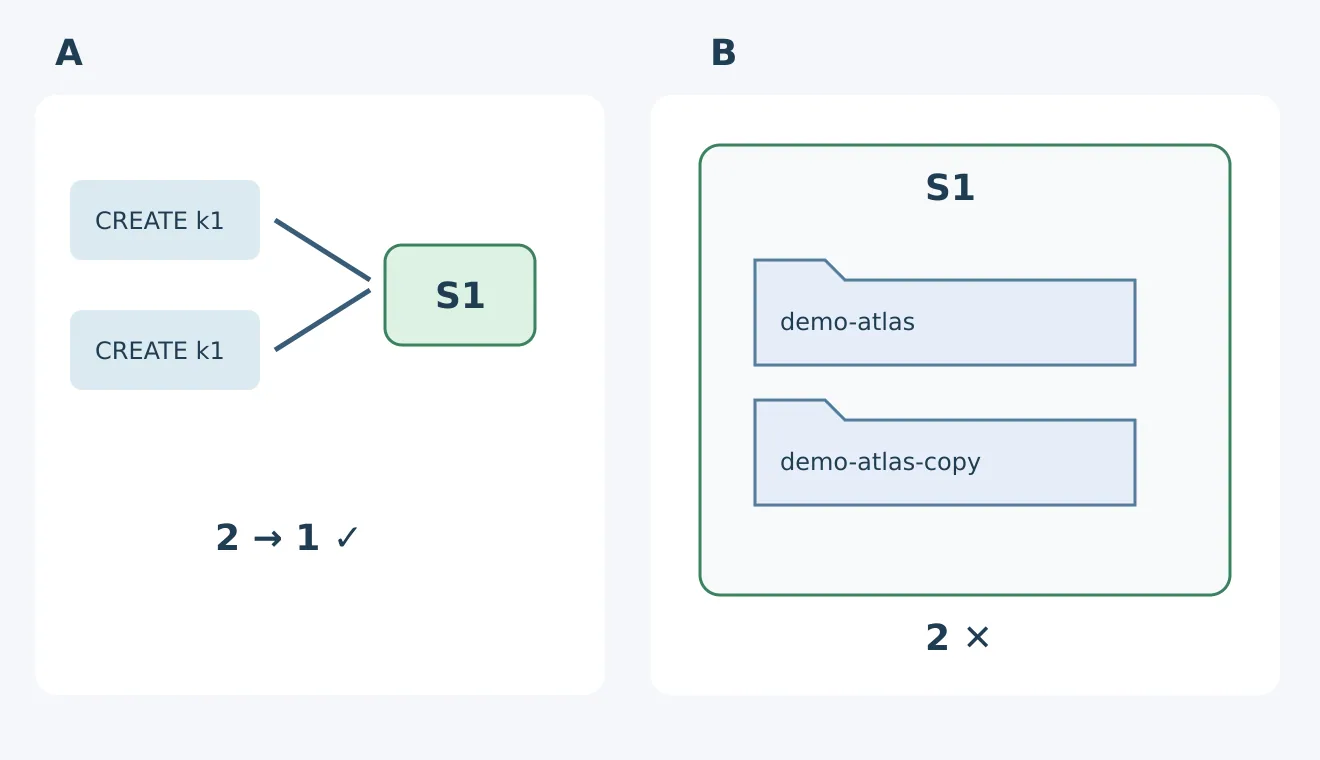
Unexecuted fictional acceptance diagram. In A, two creation requests produce only S1, illustrating environment-level deduplication. In B, S1 contains two differently named repositories, which still fails the task outcome. Creating one environment does not establish correct business retries or prove that report files have been saved.
A simple mock is a useful comparison. If your existing test already preserves state and checks records after retries, it may be enough. If the mock merely returns a fixed “Success” every time and cannot reflect the previous write, there is a reason to assess Archal's stateful environment. Compare both using identical initial data, the same task and the same final-state criterion. Do not run one with leftovers from the previous attempt while the other starts empty.
Reset, destruction and evidence retention are separate
After each test, save the non-sensitive verification results you need, then confirm that resetting really restores the declared starting state before the next run. Resetting enables reuse; it does not mean stopping the environment. When testing is finished, destroy it and verify its final status. The official client documentation says it waits for readiness and attempts cleanup if readiness fails. An attempt is no substitute for handling incomplete cleanup yourself. Idempotent sandbox creation also makes no promise to persist your test-report files automatically.
The official documentation distinguishes workspace lifecycle credentials from session- and environment-scoped connection credentials, and says not to provide real service credentials. Use only fictional objects and empty or self-made state in a selection demonstration, and record each approved test endpoint in the demonstration plan. A tool being called a sandbox does not mean other branches of your code cannot touch production. This article created no environment, ran no code, connected no real service and entered no keys.
For procurement, clarify API coverage, state-verification cost, repeat runs and the cost of waiting for environments or leaving them allocated. Compare total effort for the same test task. Passing a toy task is not cross-service safety certification. Archal can reduce the burden of maintaining test accounts and complex mocks when the team regularly reruns multistep calls from the same starting point and can verify final state, reset and cleanup. If key interface behavior does not match, keep the existing test approach or narrow the trial to one verifiable workflow.
Content note:This article is based on publicly available information and is intended as a reference for evaluating tools. Features, pricing, and related policies may change at any time; please refer to the latest official information.
Original source:www.npmjs.com