Is Articos worth it for copy review? Simulated objections are not customer evidence
Compare two versions of a fictional tool description with identical facts, and separate testable questions from synthetic preferences.
Pay to find questions, not to prove preference
Articos’s April 17, 2026 introduction describes synthetic personas, interview scripts and themed findings. For a fictional exhibit-label layout tool, use it to surface unclear language, not to infer buying intent from simulated preferences or vendor benchmarks.
Change wording, not facts
On paper, A says “export in two print sizes”; B says “export A5 and A6.” Neither claims automatic translation. Hold context and questions steady and change the presentation order. Separate misunderstandings, missing information and untestable preferences. A report that invents translation or counts repeated objections as independent evidence fails. Use fictional inputs only, without customers, websites or contact queues.
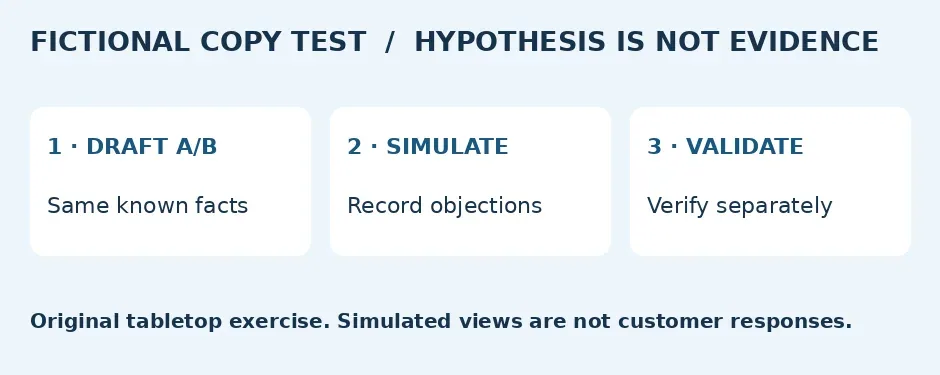
Fictional tabletop exercise, not Articos UI or measured customer feedback.
Turn findings into questions
A pass requires tracing a summary to fictional statements and the input revision, then giving an editor two independently testable questions, such as whether readers understand A5/A6. It does not yield a conversion rate. Confirm run limits, records, retention and deletion. Do not quote a simulated statement as customer testimony.
Compare a human clarity read
For a short draft, independent colleague review often costs less. Pay only when repeated debates across versions yield extra testable questions and save revision time. Real preferences require separate approved research; simulation alone does not justify release.
Content note:This article is based on publicly available information and is intended as a reference for evaluating tools. Features, pricing, and related policies may change at any time; please refer to the latest official information.
Original source:www.articos.com