Is Assort Health worth buying just to answer opening-hours questions? Separate site hours from operator availability
For public opening hours and administrative transfers, compare the existing phone menu first. Use fictional mismatched site and staffing hours to assess Assort’s scope controls, handoffs and upkeep costs; round-the-clock answering does not mean round-the-clock human staffing.
If a clinic’s switchboard only needs to answer “Which location opens when, and how do I reach administrative staff?”, Assort Health’s round-the-clock answering is not by itself a reason to replace the existing phone menu. The official product positioning spans appointments, information collection and follow-up work, with an emphasis on EHR/PMS connections: electronic health records and practice management systems. Buying that whole workflow for a few public answers could turn simple upkeep into an integration project. Further comparison is worthwhile only if natural phrasing and multiple locations’ rules genuinely make the current menu difficult, and the supplier can demonstrate that the scope can be confined to approved administrative information.
Assort’s official IVR comparison says that a traditional menu can play administrative information such as opening hours and directions; the vendor also lists context-carrying human handoffs as a capability of its voice agent. That supports comparing two service-desk entry points. It does not prove that a particular clinic can already disable every other action, or that somebody will always answer a transferred call. What follows is only a paper-based purchasing check for a fictional clinic. No product is run, calls made, business systems connected or patient data used.
Treat site opening and human staffing as separate rules
Suppose fictional site A opens on weekdays from 09:00 to 17:00, but its administrative switchboard is staffed only from 09:00 to 16:00. Site B closes on Wednesdays, while its administrative switchboard remains staffed. The public-information sheet must separately record site hours, human answering hours, exception dates and the person responsible for updates. A Wednesday question about visiting B should receive the answer that B is closed. A request to speak to administrative staff at the same time must not be treated as unanswerable merely because the site is closed. Conversely, at 16:30 the system may say that A is still open, but must not promise immediate access to administrative staff.
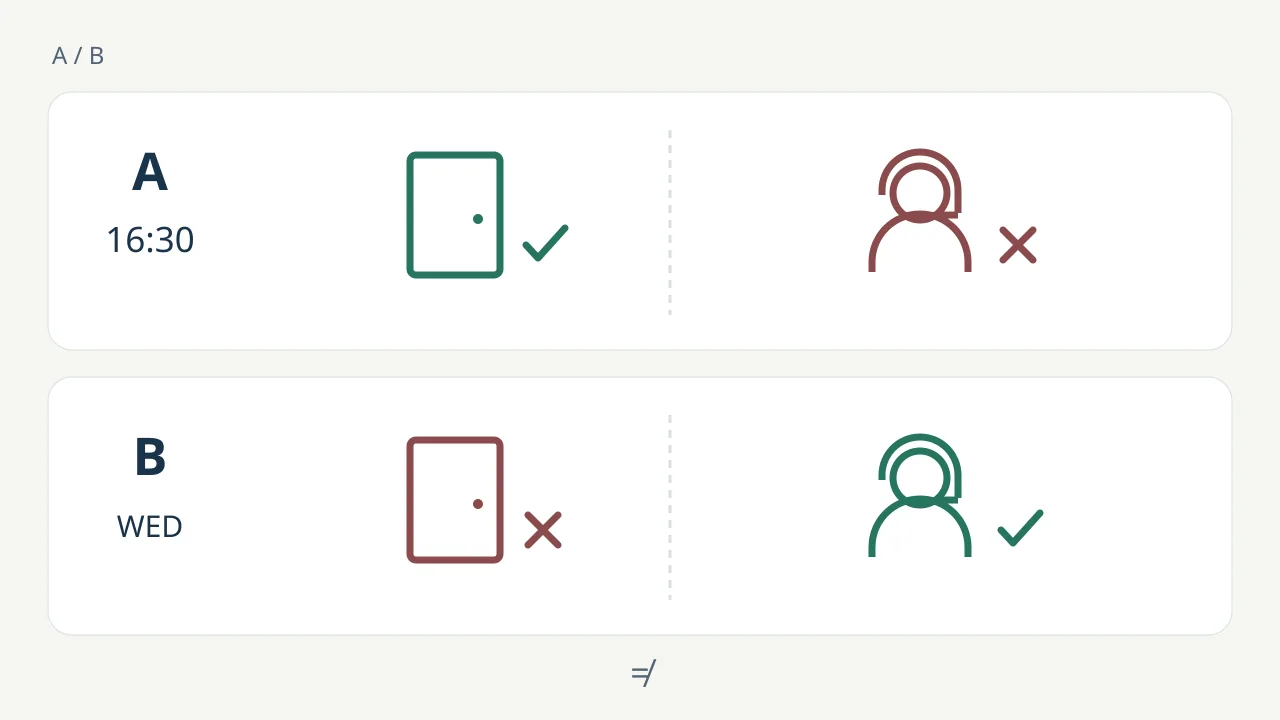
Fictional rules, not a product interface or test results. At 16:30 A is still open but administrative staffing has ended; on Wednesday (WED) B is closed while administrative staff may still be on duty. Site hours and human answering availability cannot share one switch. The check beside a person means only that staff are on duty; an actual connection requires separate confirmation.
A purchasing demonstration should explore this mismatch, rather than merely let you hear a fluent greeting. Ask the supplier to use entirely synthetic information to show both “site open, staff off duty” and “site closed, staff on duty”, with different phrasings of the same public question. Compare against answers written in advance: was the correct site selected, was the exception respected, and was a transfer request described separately from an established connection? If there is no approved answer, the result should remain unknown, with an approved administrative next step, rather than an inference from another location. Any request beyond public administrative questions falls outside this demonstration; do not use it to evaluate clinical handling.
Compare saved explanation time with added upkeep
A handoff with context is valuable only if the recipient actually gets the administrative information they need. This example requires only the site, the public question and whether a response is still pending. There is no reason to collect identity, symptoms or consultation records just to answer opening-hours questions. Ask the supplier to explain whether this limited scope is achievable, which actions can be disabled, who may edit answers, how an old version is withdrawn and what is said when a human is unavailable. “Can integrate” does not mean that health records must be connected, and a purchasing demonstration is no reason to expand any access permissions.
Compare the existing menu and the proposed option on the same synthetic questions: count correct answers, successful human handoffs and explicitly pending items separately; record time spent explaining back and forth and who must act to correct an exception date. An attempted transfer is not a connected call, and the end of a call does not mean the question is resolved. These are proposed acceptance records, not measured Assort results. If a fixed menu already covers both locations’ hours and human contact routes clearly, improving the recordings and assigning upkeep responsibility is often more direct than introducing another platform.
Finally, obtain a written quote for this narrow scope, clarifying whether initial configuration, call usage, human handoffs, exception changes and ongoing support are charged separately. Compare staff time saved on the same administrative questions with new fees, review effort and upkeep; do not count appointment revenue or clinical outcomes as benefits. Keep the existing entry point if the supplier cannot explain how to limit the service to this need, or if less explanation work does not offset the new burden. Proceed with this administrative service-desk purchase only when the scope is verifiable, handoffs traceable and the total cost worthwhile.
Content note:This article is based on publicly available information and is intended as a reference for evaluating tools. Features, pricing, and related policies may change at any time; please refer to the latest official information.
Original source:web.archive.org