AstraPixels: is a pixel-art solar system enough, or do you need an ephemeris?
Separate a public orientation map from repeatable observing data.
Choose AstraPixels for a visitor-friendly comparison of approximate relative positions. The maker launched a pixel-art solar system in August 2026, and the site says it computes positions from published orbital elements. Custom names appear only there, not as IAU designations. A tour does not require buying a name. (Source)
Draw two fictional orbit diagrams. A square sits toward the lower left in one, and the upper right in the other. Viewers can see that positions change over time; they cannot infer distance, visibility or the sky direction from the ground by counting pixels. These are neither ephemerides nor product output.
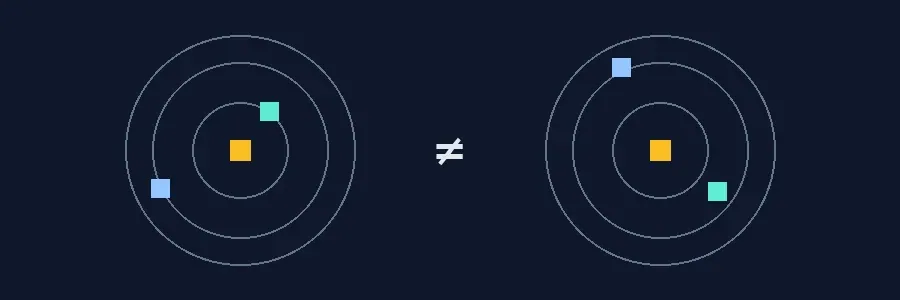
Original sketch, not to scale. Position on a map is not a direction from the ground.
Write two checks: “Which side is the object on?” and “Can I find the time and source?” For orientation, label the map a visual guide. For visibility from a specific place or a reproducible position, require date, time zone, location and coordinate frame and use an authoritative ephemeris. Explain the same question twice; choose the visual only if it speeds understanding without turning aliases or pixels into evidence.
Content note:This article is based on publicly available information and is intended as a reference for evaluating tools. Features, pricing, and related policies may change at any time; please refer to the latest official information.
Original source:www.producthunt.com