Atlaso buying guide: check project scope and revisions before sharing decisions across tools
Atlaso gives multiple AI tools a hosted shared memory. It is geared toward people who regularly switch tools and have to repeat project context. Its value depends on keeping projects separate, preserving support for revisions and accounting for review time. A remembered decision cannot replace formal approval.
Every time you switch AI tools on the same project, you may have to explain naming conventions, the scope of delivery and the last decision all over again. That repetition is the problem worth considering Atlaso for. If you use just one tool, or a clear project page already does the job, shared memory may not justify adding a service. For frequent cross-tool work, the question is whether the next tool gets the right project decision with a way to trace the revision, not how many entries it remembers.
Atlaso's official MCP documentation describes a hosted memory service: connected tools share persistent memory, and the service itself is not open-source software you can self-host. The documentation distinguishes personal memory, which follows the individual, from project memory scoped to a repository or workspace. It also distinguishes standard MCP connections from the hooks that give some terminal tools automatic recall and capture. A client that can connect does not necessarily capture memories automatically in the same way. This guide examines what the documentation supports for a buying decision; no client was installed or connected.
Use two entirely fictional exhibition projects for a paper exercise. The personal preference is “use short sentences in drafts.” Project A was originally due to deliver 16 posters, but the formal project brief revised that figure to 24. Project B still needs just 8. When the next tool works on A, it should retain the short-sentence preference and use the documented revision to 24, not pull in B's 8. Likewise, B should not inherit A's 24. All numbers are made up for the exercise, not Atlaso limits or quotas.
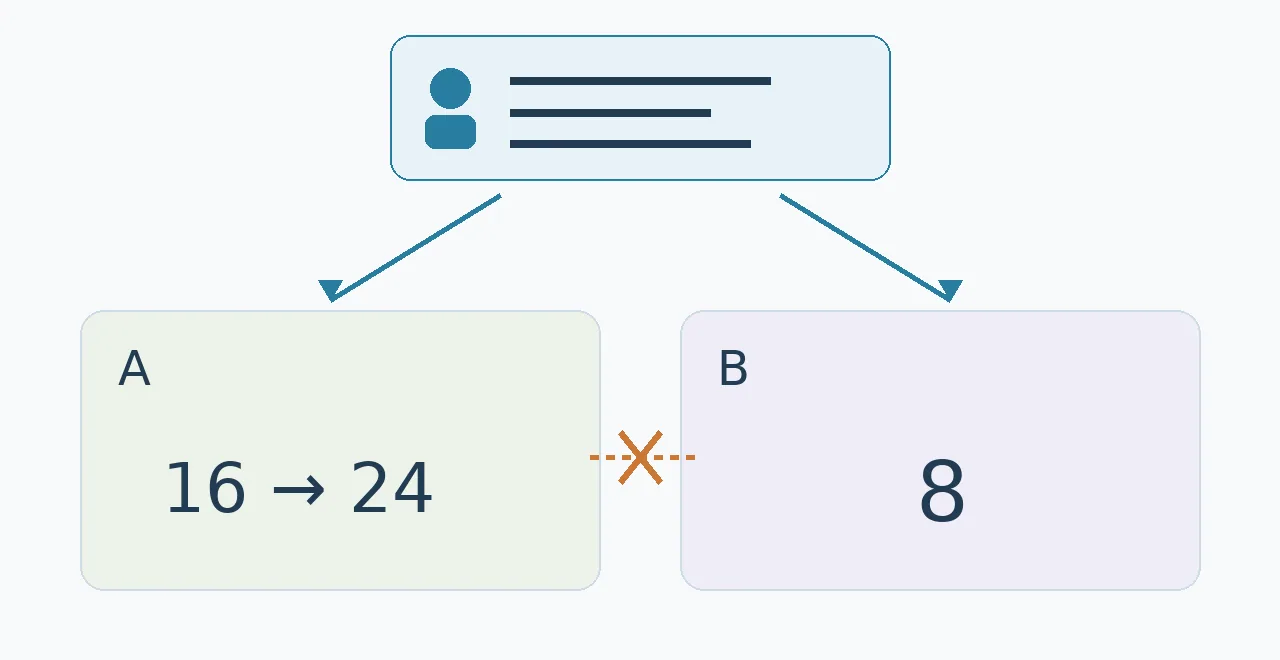
Original paper illustration, not an Atlaso interface or test result. The personal preference above applies to both projects; A and B below are separate records. A's change from 16 to 24 requires checking the source, while B remains at 8. The dashed line and cross flag a mix-up to check for; they do not establish that isolation has been verified.
Check three things separately. First, the writing preference can carry over, but each quantity should stay with its project. Second, the change from 16 to 24 in A should trace back to the specified new brief. A chat that mentions 24 does not constitute approval. Third, if older and newer records conflict, the output should make that conflict possible to investigate instead of smoothing it over. The official documentation says recall returns a settled or contested verdict. That verdict signals the state of a memory; it is not an approval signature and does not independently prove the quantity. Ask the vendor to demonstrate sources and revision results on the same fictional records rather than uploading real customer material to see what happens.
Read and write boundaries also affect maintenance costs. The documentation lists recall, recent and status as reads; remember saves a durable note, and forget is irreversible. Deleting an old memory is therefore not the revision method proposed here, nor does it establish that content already copied into another chat or file has been erased. Before assigning internal upkeep, ask the vendor to explain how a person can review mistaken entries, conflicts and exported copies. Do not treat documented project scope as independently verified access control or a compliance guarantee. This example uses only invented, nonsensitive records.
A versioned handoff page with an owner is the alternative. It records the current decision, the project it applies to, its source and the rule it replaces. You need to supply it to the next tool manually, but it is straightforward to tell which version governs. That may be simpler if there are few switches. Atlaso can reduce repetitive explanations and searching, but compare the same tasks and require the same factual completeness. Time saved copying context is not all net benefit if someone still has to check whether memories are out of date.
The plan limits in the official documentation matter to this decision. Free covers one device and one tool. Pro is listed at $10 per month for sharing memory across unlimited devices and tools and includes JSON export. Build costs $25 per month and adds the developer memory API. The $ symbol follows the documentation; check the written quote or checkout information for the currency and taxes rather than assuming them. The goal here is shared memory across two tools. Trying one tool for free does not validate that full goal, and there is no reason to choose Build for a developer API you would not use.
Suppose you switch tools 10 times a week. At four minutes per switch to restate context, that's 40 minutes. With shared memory, allow two minutes per switch to review it and another 12 minutes each week to handle changes and mistaken entries. That's 32 minutes, for a net saving of only eight minutes. This is a budget illustration, not a product test, and it does not deduct setup, learning or exception-handling time. If fact-checking takes longer on real projects, the benefit may disappear. Value the net time at your team's own rate and compare it with subscription and upkeep costs rather than using the number of memories as the purchasing metric.
Atlaso belongs in the daily workflow only if cross-tool repetition is genuinely frequent, the sample project and version results can be explained clearly, and someone owns review and revisions. Teams with few projects, teams that cannot give a hosted service the necessary material, or teams required to keep formal decisions in an existing approval system should retain their handoff pages and original approval records. Shared memory can help recover context. The authoritative source for a formal decision should still be independently accessible.
Content note:This article is based on publicly available information and is intended as a reference for evaluating tools. Features, pricing, and related policies may change at any time; please refer to the latest official information.
Original source:github.com