Choosing AutoHDR: a brighter window should still show the same view
Compare automatic exposure blending and your current workflow using the same mock scene. Check the frame, the outdoor marker and interior colors before adopting.
If balancing bright windows and dim rooms repeatedly costs you time in property photography, AutoHDR is worth comparing. For a small workload with consistent manual blending or color work, a new tool may not be necessary. In 2025, the team described blending exposures, analyzing brightness and masking the window area to manage exterior brightness. That is the vendor’s description, not proof that every image stays faithful or meets listing-platform requirements.
Use a cardboard window, not a real listing
Make a tabletop cardboard window. Place a card with a blue stripe outside the mock window and gray and yellow cards inside. Keep framing and camera angle fixed, and make three exposures of the same scene. Use the darker frame for the blue stripe, the middle one for frame geometry and the brighter one for interior shadows. Retain the originals and compare automatic blending and your current method on the same input. Test only basic exposure blending: if you cannot verify that a setting avoids adding or removing objects, replacing the view or altering scene contents, do not deliver with it. This is an acceptance plan; nothing was uploaded or run.
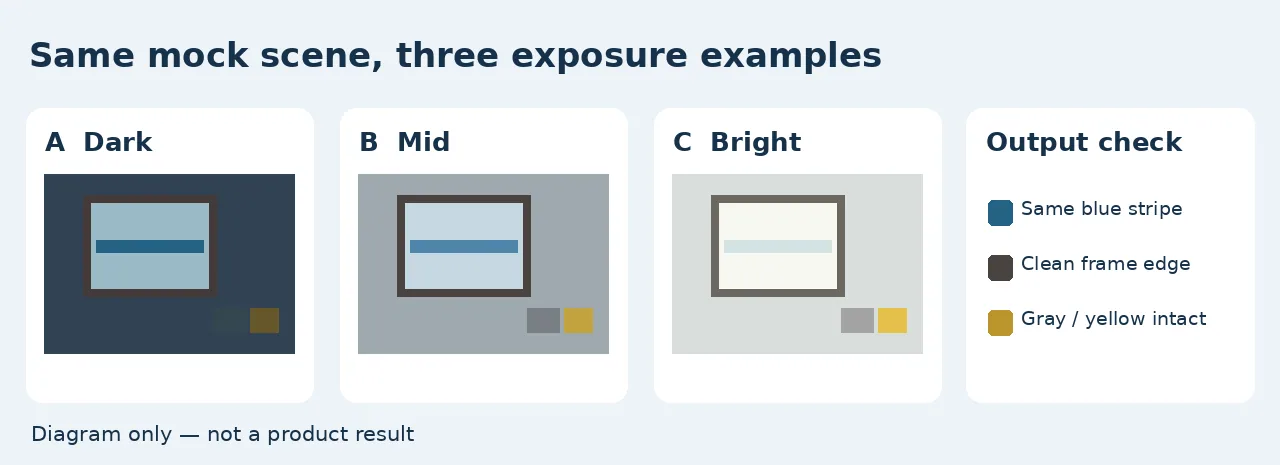
Original cardboard-window diagram, not an AutoHDR output or result. Exposure varies, but the stripe, frame and cards still belong to the same scene.
Check fidelity before counting costs
Compare the candidate with the source side by side. The outside stripe must stay the same, not be filled with a different view. The frame should show no doubled or obvious bright edge, the gray card should not take on a strong color cast and the yellow should not become a different color. If the corresponding detail is not visible in the source, do not call newly made content “recovery.” Use manual editing with traceable source details or reshoot. Before delivery, review against your business and platform rules; automated acceptance does not replace human review.
Record the time spent organizing inputs, reviewing results, reworking and exporting; check whether reprocessing or re-exporting the same angle costs extra. Apply one standard to both options instead of treating the speed of the first automated draft as total throughput. Expand only if window and scene details remain traceable, rework is manageable and the total cost per deliverable image is better.
Content note:This article is based on publicly available information and is intended as a reference for evaluating tools. Features, pricing, and related policies may change at any time; please refer to the latest official information.
Original source:www.autohdr.com