BearDrive buying guide: the synced winner is not the final edit
Two editors change the same exhibit label. The file that keeps its name need not be the one to print. Use two paper-only scenarios to test whether BearDrive’s history is worth adopting.
Separate the sync winner from the approved text
BearDrive keeps shared work as ordinary files in a working folder. Its official v0.15.0 documentation says offline edits are recorded locally and synced once the connection returns. When both sides edit the same path, the conflict rule decides which version stays there; the other survives as a conflict copy. History shows the account, device and time associated with a change. This solves “where did the other edit go?”, not “which one should we print?”
One fictional exhibit label, two kinds of conflict
Write three cards on paper. The baseline card.txt says “blue paper, mount on the left.” A changes only left to right. B changes only blue to white. Suppose B stays on the original path and A becomes the conflict copy. Ask someone who did not make the edits to identify the position and color changes from the baseline and both drafts. They should write the candidate “white paper, mount on the right” for an editor to approve. Keep both drafts in the acceptance record.
Repeat with A specifying “right” and B “center.” The two values now conflict, so the same merge is not possible. A passing record identifies who changed what, which point needs a decision, and who will approve the final text. A tidy original path is not enough.
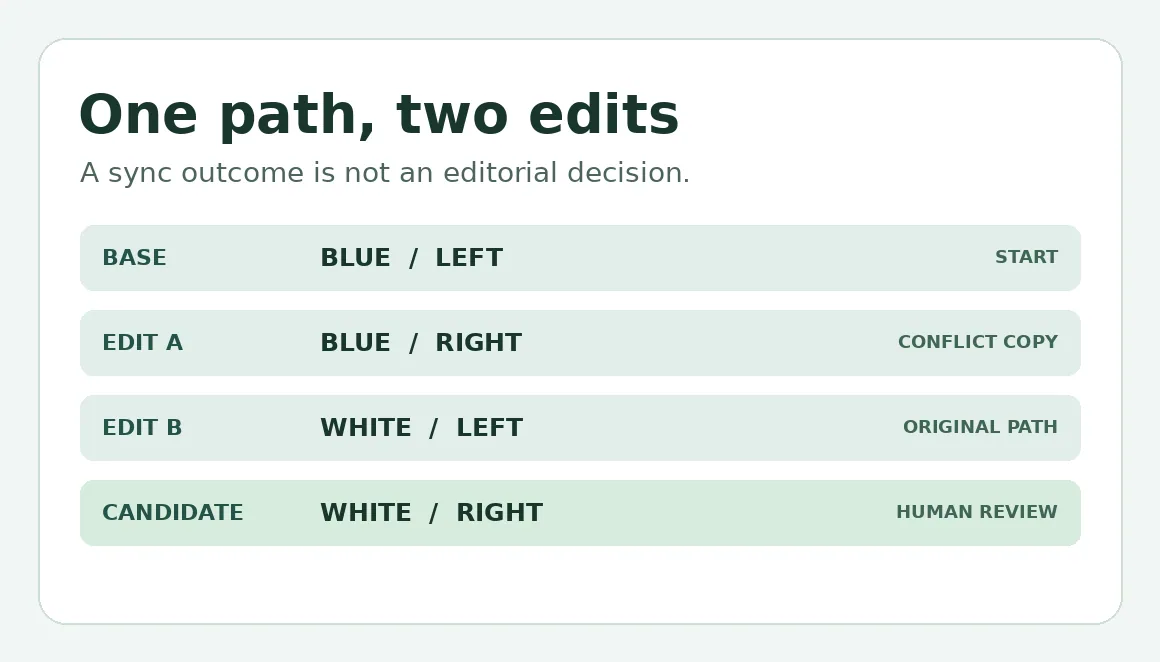
Original paper-card diagram. Sync decides where each file lands; an editor decides what to use. Record both decisions.
When it is not worth switching
Consider BearDrive when a team regularly edits the same ordinary files offline and needs later readers to recover context from history and copies. When there is usually one editor, a read-only copy after approval may suffice. If each change needs approval and conflicts must not reach delivery, keep that approval separate from sync. Count the time needed for conflict review and the cost of shared storage. Check device compatibility, the scope of stored files, and how history is retained and retrieved. This exercise uses handmade cards only; no working folder is connected and no links are opened to others.
Content note:This article is based on publicly available information and is intended as a reference for evaluating tools. Features, pricing, and related policies may change at any time; please refer to the latest official information.
Original source:raw.githubusercontent.com