Is BeatBun worth using under narration? Check the two seconds of silence
Compare BeatBun with cleared library music on a fictional 20-second narration. Check speech clarity, unwanted voices and whether the tail ends by 18 seconds, then count audition and rework time.
If you keep looking for short background music that supports a narration’s opening and gets out of the way on time, BeatBun is worth considering for an instrumental cue. If a cleared music library already has an excerpt with a suitable length and ending, editing it into the piece is usually easier. Compare what works in the finished cut, not which track sounds better in isolation.
Mark the quiet interval before trying a music bed
BeatBun’s official production guide describes an instrumental option. Simple mode starts from one description; Custom mode separates style guidance from lyric input. The guide also mentions that voices can appear even when background music is intended. That supports checking for voices. It does not prove every generation will respect a duration or ending.
Sketch a fictional 20-second clip. The first 18 seconds are your own spoken exhibit description and you only consider instrumental music without voices. Start bringing the music down at 16 seconds and have it stop by 18, leaving the final two seconds completely silent. Give the same timeline to two candidates: an instrumental proposed for BeatBun and an already cleared library excerpt. A fade that starts at 16 but leaves a tail at 19 has not left two full seconds. A cue that stops on time but obscures a key word also fails. These are not problems unique to generated music; the library excerpt deserves the same edit and listening checks.
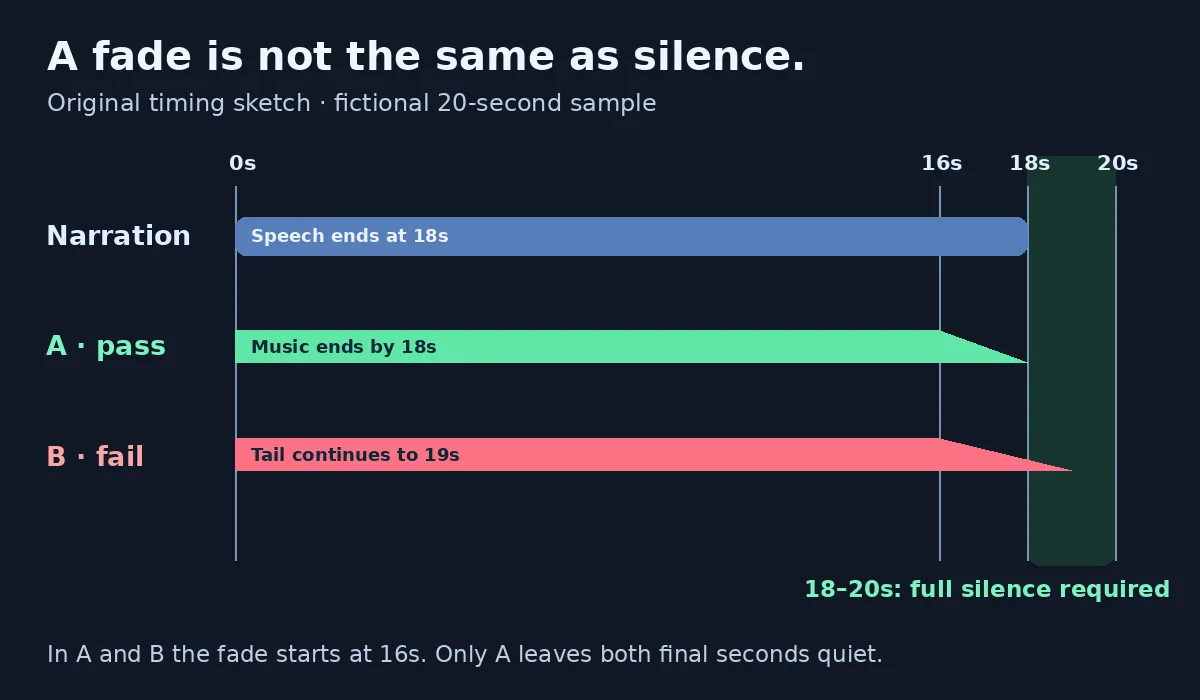
The 18–20 second interval must be completely silent. Both excerpts start fading at 16; a tail beyond 18 fails. This is a fictional check, not a product screen or an audition result.
Write three checks on paper: can you understand the opening and the words near the end, are any identifiable or voice-like sounds present, and does the music tail finish before the quiet interval? Evaluate only instrumental samples you created or whose rights have been verified, listening under the intended playback conditions. As needed, note what should be reduced, trimmed or rejected. Fading alone does not necessarily remove reverb tails; do not cover a tail with a new sound instead of silence. No audio was generated, auditioned or uploaded for this article. It uses no existing works, third-party recordings or voice imitation.
Count the time for an excerpt that still works after editing
Track time to find or prepare material, audition it, edit it and listen again. Compare the efforts needed to reach the same delivery threshold. If you only need one short insert and regeneration, selection and cleanup take longer than cutting a library excerpt, keep the existing approach. Consider adding generation only if the library often lacks suitable beds and you can repeatedly select ones that keep words clear, add no voices and leave two full silent seconds.
Passing the audio checks does not make an excerpt usable. Either way, retain permission evidence that applies to the exact material and separately check project use, distribution channels and any credit requirements. Do not use it if the evidence is insufficient, even if the edit fits. Before paying, check whether you can obtain audio that suits your editor and what it will cost overall. An instrumental feature description establishes neither the plan you need, nor download access, nor suitability for every channel.
Content note:This article is based on publicly available information and is intended as a reference for evaluating tools. Features, pricing, and related policies may change at any time; please refer to the latest official information.
Original source:beatbun.com