Choosing BigPanda: did you lose duplicate alerts or separate problems?
Use four fictional exhibit cards to count false and missed merges, without mistaking a group for an established cause.
Check group boundaries before counting alerts
BigPanda is worth comparing when a team receives many similar notifications but struggles to decide which belong together. Its 2024 release notes introduced an alert correlation dashboard. A 2025 report describes clustering related alerts into incident groups. Halving the count may remove duplicates or combine two problems that need separate attention. Do not judge by counts alone.
Four paper cards are enough for a first pass
For a fictional model exhibition, A and B both record a chipped corner on label P-01. C records the wrong color on label P-02, and D an undecided location for stand P-03. Write the human reference first: A and B together, C and D individually. This says which records belong together, not what caused the chip, color choice or unassigned location.
Count errors by pair. If candidate one groups A, B and C, leaving D separate, it has just two groups but two false merges: A–C and B–C. A–B stays together, so that pair is not missed. If all four are separate, there are no false merges but one missed merge, A–B. Two false pairs do not mean two independent issues disappeared; the same C participates twice. Check each card on paper, making sure C remains listed for a separate review.
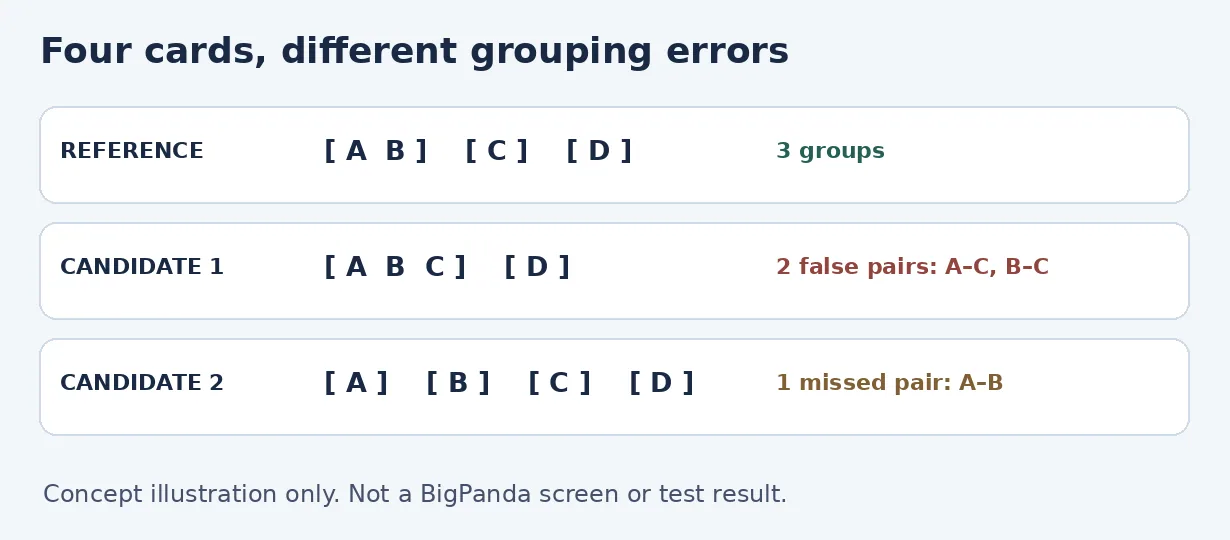
Original paper verification graphic, not a BigPanda screen or result. Group count is not error count; grouping does not establish cause.
When a manual list is enough
Repeat with another harmless set of cards. Write the reference before comparing your list with the provider's proposed grouping. Record incorrect pairs and the time spent splitting or merging by hand. Mark “grouped for review” and “cause established” as different states. If notifications are uncommon, or human review still takes longer and must cover each item, the current list may be better. Compare quotes and handover work only if grouping reduces review effort without hiding separate issues. This is a paper exercise; no data, devices, monitoring systems or automation were connected.
Content note:This article is based on publicly available information and is intended as a reference for evaluating tools. Features, pricing, and related policies may change at any time; please refer to the latest official information.
Original source:docs.bigpanda.io