Choosing BlazeSQL: why do three display records count as only two exhibits?
Use four fictional cards to verify what each count means and decide whether conversational analytics saves time.
Say what the answer counts
BlazeSQL is worth comparing when a team gets many ad hoc number requests and keeps having to ask whether to count records or exhibits. Its product page describes natural-language data questions, examples and feedback for business context. That does not guarantee correctness. Record counts, distinct exhibits and draft exclusions can produce different answers from the same material. For a few fixed questions, an existing report or sheet with definitions may be simpler.
Verify three answers with four fictional cards
In a paper model exhibition, A-01 has two “Displayed” records, A-02 has one “Displayed” record and A-03 has one “Draft” record. On paper the total is 4, displayed records are 3, and distinct exhibits with at least one displayed record are 2. See whether a paper demo can trace those numbers to the cards without real data and explain why A-01 counts twice as a record but once as an exhibit. A number without its definition does not pass.
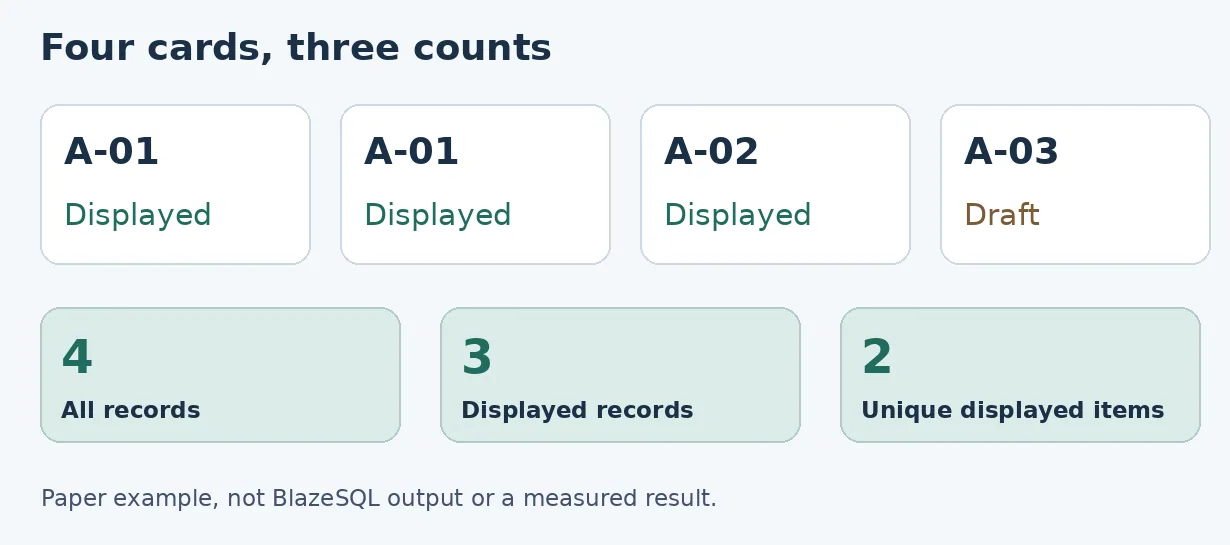
Original paper exercise, not a BlazeSQL screen or measurement. Three records do not mean three exhibits.
Change the A-03 card to “Displayed”: total records remain 4, displayed records reach 4, and distinct displayed exhibits reach 3. Have the same reviewer check the before and after cards, record disagreements and add one definition. If “displayed” has not been agreed as a record or exhibit count, settle it with people before relying on a fluent answer. This is a paper procurement exercise, not a test result; nothing was queried, uploaded, connected, provided as credentials or executed.
Include the cost of maintaining definitions
Compare the time to maintain definitions, investigate anomalies and update existing reports. Names like desktop and web are not enough. February 2026 terms describe server sync for schema metadata and chats in the desktop scenario; the same month’s privacy policy says results stay on the device when default offline mode is on but are also sent when it is off. The web app stores results and other data server-side. Confirm the actual mode. If nothing may leave the device, local results alone do not pass. Continue only when the rule is defensible and the explanation time saved exceeds upkeep and review.
Content note:This article is based on publicly available information and is intended as a reference for evaluating tools. Features, pricing, and related policies may change at any time; please refer to the latest official information.
Original source:www.blazesql.com