Blinkist AI guide: When is a summary enough, and when should you read the original?
Use a two-part handout you wrote yourself to see whether an Extract could save reading time without turning one example into a general conclusion.
Decide which step to save
Blinkist’s March 2026 help says Pro users can turn supported links or files into Extracts in the mobile app and revisit or listen to them in My Library. The benefit is putting material that only needs a first pass into your existing reading and listening routine, not checking one summary for omissions by reading another. If you need browser access, original quotations, exact limitations, or verifiable evidence, don’t rely on the Extract alone.
One handout, two reading decisions
Use a self-written, two-part handout for a paper exercise. The first part simply gives the order for a fictional exhibit: put out the title card, then the example card. If all you need is to remember that order, a summary that preserves both steps is enough. The second part explains why one trial reversed the cards: the entry was dim that time, and observers found the example card sooner after it moved to a brighter spot. The handout compares no other lighting conditions and does not measure audience understanding.
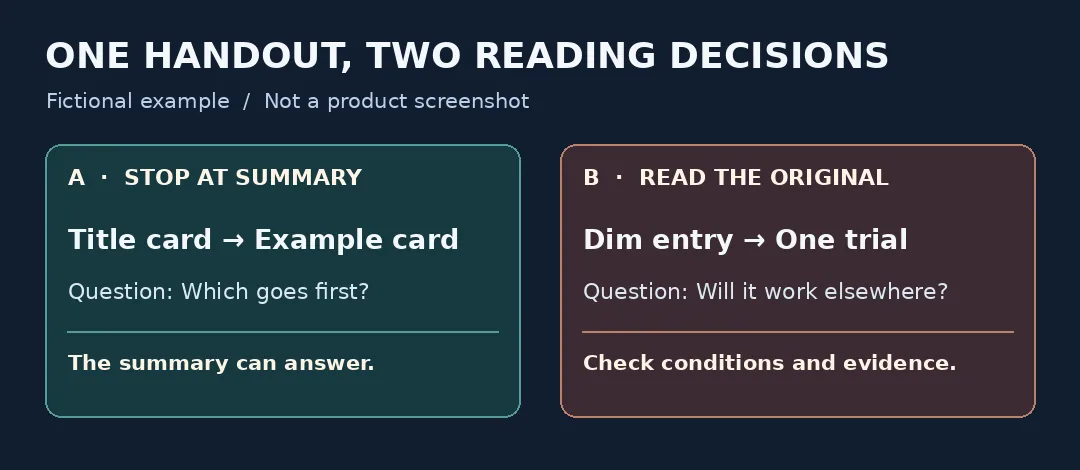
A summary can give the sequence, but it cannot establish that a single trial applies at another venue. Original paper example, not a product screenshot.
When to return to the source instead of reading another summary
If a summary says “putting out the example card first works better,” it promotes one trial to a general rule and replaces “found sooner” with an undefined “works better.” Before changing another display on that basis, read the second part to check the lighting, who was observed, and what the handout actually recorded. If you want to know whether visitors understood more, you need new evidence. Another summary cannot supply a comparison the handout never made.
What would justify paying for Pro?
Keep acceptance simple: after the summary, a reader should be able to state the first part’s sequence without opening the source, and should not mistake the second part for a prediction about another exhibit. This is a paper example, not actual Blinkist AI output. If you mainly listen to long material on your phone and only need to go back at a few critical points, Extract is worth considering. If the material is brief, every condition affects the decision, or you do not have permission to upload it, reading the original you already have is simpler.
Content note:This article is based on publicly available information and is intended as a reference for evaluating tools. Features, pricing, and related policies may change at any time; please refer to the latest official information.
Original source:support.blinkist.com