Build Check guide: An idea score is a starting point. How do you check whether to build?
Use a fictional label project to separate a quiz score from a paper check. Define one problem, then compare with the existing labels.
A score finds questions, not proof of demand
Build Check launched on Product Hunt in April 2026. The maker described a first-pass questionnaire that evaluates ideas across six dimensions and mentioned a 48-hour check before development. Its value is prompting you to check the weakest assumption first, such as how often the problem occurs, not turning a letter grade into evidence of demand or returns. Your answers reflect your judgments; they don’t replace observation.
Turn one fictional idea into a question you can check
Suppose you want a small tool that generates labels for boxes of model parts because two rods of the same length are easy to mix up. Instead of “make labels look better,” ask “Can the label alone identify the rod with the requested connector?” Write two sets of fictional labels on paper, two labels per set. Both old labels say “Rod | 8 cm”; the new ones say “Rod | 8 cm | Round” and “Rod | 8 cm | Square.” Give yourself one task card: “Find the 8 cm rod with a round connector.” Don’t build a site, write software, or contact anyone.
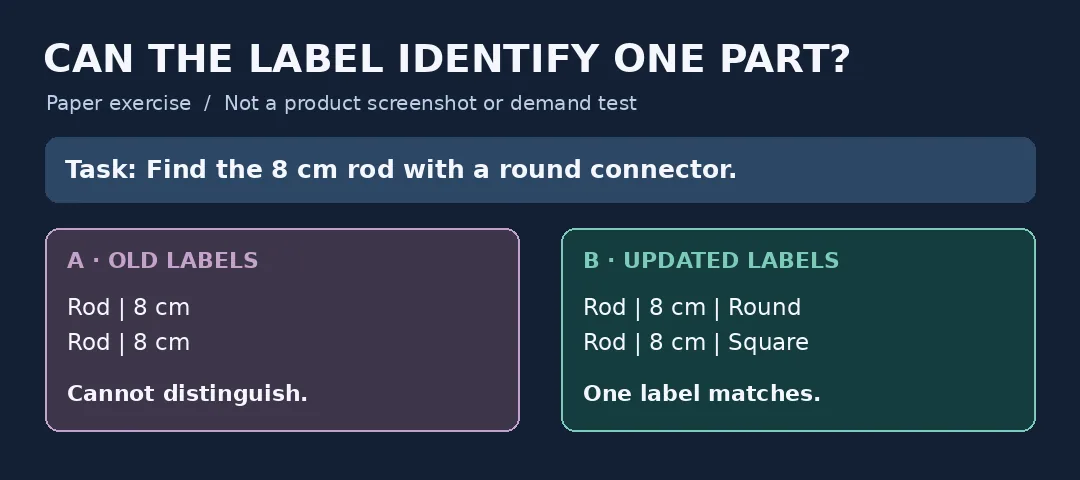
A score can suggest where to start. This paper comparison only shows that a field distinguishes two model parts. Original illustration, not a screenshot or demand evidence.
Set the criterion before looking at the paper result
Set a pass criterion: the labels alone must identify one match without guessing. The old labels both say 8 cm and omit the connector, so the result is “cannot distinguish,” not “select the first.” Only one new label says round, so it passes on paper. That shows the field addresses this example, not that users encounter the problem, will switch tools, or will avoid errors over time. A 48-hour limit bounds the check; the time running out does not prove demand. This is an original paper exercise, not use of Build Check or contact with real users.
When to use a questionnaire and when to skip it
If you have several ideas and don’t know which assumption to check first, consider Build Check’s approach. If the issue and comparison are already clear, a paper comparison is enough. If the only difference is a missing field on a label, try updating the existing template before making a new tool. Don’t expand a project just because the grade looks good. If your idea includes nonpublic project details, write a generic version offline and don’t submit the original.
Content note:This article is based on publicly available information and is intended as a reference for evaluating tools. Features, pricing, and related policies may change at any time; please refer to the latest official information.
Original source:www.producthunt.com