Canvass AI buying guide: Which rule applies in a familiar tool?
Two rules with the same title and three fictional questions test when to choose a source and when to clarify the audience.
A convenient answer channel does not guarantee the right rule
Canvass AI presents its service as finding information in existing systems and delivering answers in tools staff already use. Compare whether answers to the same question from different roles point to the applicable rule and explain the basis. Vendor efficiency figures do not answer this, and the positioning does not establish automatic audience inference or access enforcement. This exercise uses fictional public-style rules; it does not test access control.
Two identically titled sources, three paper questions
Create two “Label pickup” cards for a fictional community exhibit. Exhibitors collect their own labels at the blue table; setup volunteers collect spares at the green table. Mark the audience and title on each; they take effect together, with no newer-source preference. Prepare an exhibitor’s question, a volunteer’s question and a third without a role: “Where do I get a label?” Paper stands in for two familiar channels. There is no sign-in, connection, real person or internal data.
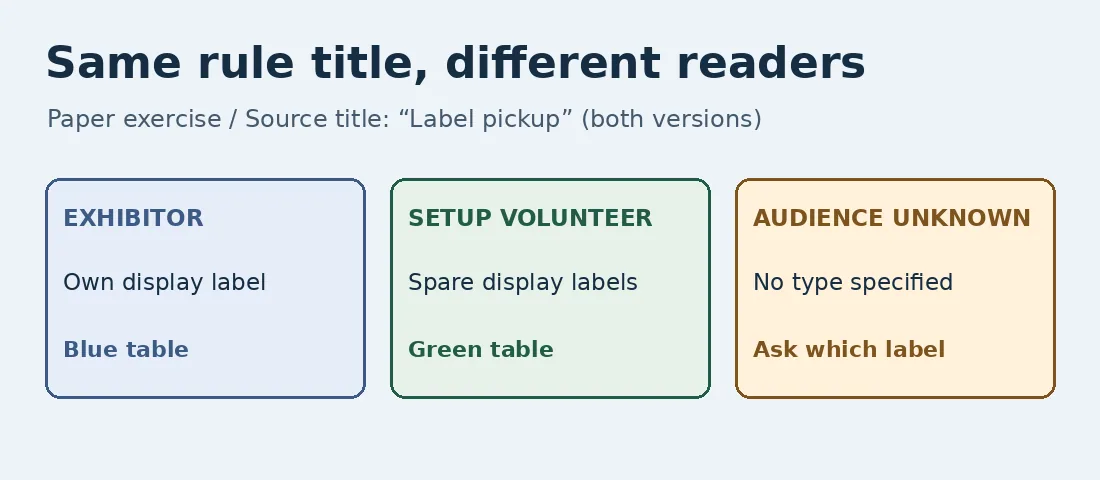
Original paper illustration, not a Canvass AI screenshot or test. Both rules are titled “Label pickup”; distinguish by audience and do not guess the third role.
Ask another reader to write three answers. The first two should say blue and green respectively and identify the audience version. For the third, ask whether they mean an exhibitor’s label or a spare rather than guessing. Listing both tables without their audiences fails. Give the reviewer the answer and its source together. This is not a Canvass AI test or a claim that it identifies people.
When two lines of guidance are easier
If identically named rules are dispersed and audiences vary, compare whether Canvass AI retains source and audience clues in the intended channel and can return an underspecified question for human review. Include correction and rule maintenance. If just two rules are easy to find, write two audience-specific lines in the existing channel instead of introducing a knowledge system.
Content note:This article is based on publicly available information and is intended as a reference for evaluating tools. Features, pricing, and related policies may change at any time; please refer to the latest official information.
Original source:web.archive.org