Choosing Catnip.AI: More generated frames do not mean a shorter wait for the first frame
Read MaineCoon’s throughput on a fictional timeline, separating the initial wait from generation speed after preparation.
If you read Catnip.AI’s MaineCoon research to shortlist real-time audiovisual systems, first ask where its frame-rate clock starts. The June 2026 first version defines sampling throughput as new video frames per second. Tests used one H100, at 480p, for a 20-second generation, and timing started after the input condition was prepared. That describes generation speed under those conditions, not how long a person waits from request to first frame.
Draw a completely fictional timeline: request received, input ready, first frame visible. Mark ‘request to first frame’ in one color and ‘new frames generated after input is ready’ in another. Ask whether knowing only the latter lets you infer the former. It does not. The example contains no numbers, media, or real people’s audio or video. It does not connect to or run the model and is not a performance retest.
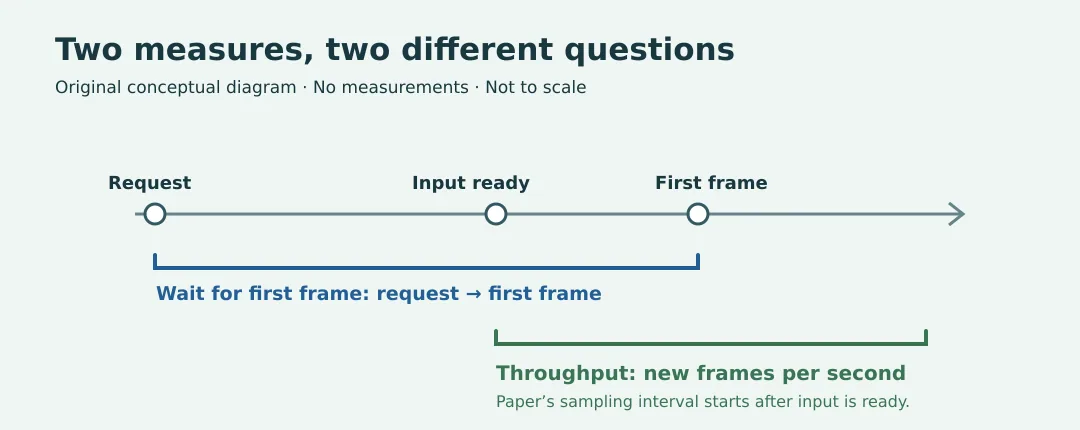
If you only need to compare generation speed under matching conditions, the paper’s throughput is worth reading. If your decision depends on how long a static preview takes to appear, ask for first-frame wait with a consistent definition of start and finish and align those boundaries on paper. Without that evidence, leave the wait unknown rather than turning a high frame rate in early research into a delivery promise.
Content note:This article is based on publicly available information and is intended as a reference for evaluating tools. Features, pricing, and related policies may change at any time; please refer to the latest official information.
Original source:arxiv.org