Cerebrium buying guide: Ready is not the same as first result delivered
Two invented timelines separate readiness and processing from the user’s first-result wait.
Ask where the clock stops
Cerebrium’s July 1, 2026 technical article distinguishes application startup from readiness to serve and describes the purpose of retaining a warmed state. For a serverless inference comparison, ask whether the figure covers startup to readiness, work after readiness, or the time from request to first usable result. They are not interchangeable. This is a paper check, not vendor performance evidence or deployment guidance.
The same fictional task on two timelines
Imagine requesting a draft exhibit label for a paper-art show. Both cards use second zero as the shared paper baseline for request sent and received. A is not ready until second six and delivers its first usable draft at second eight. B is ready at arrival and delivers at second two. These numbers are invented, not latency measurements, benchmarks or case frequencies. No real service or data is involved.
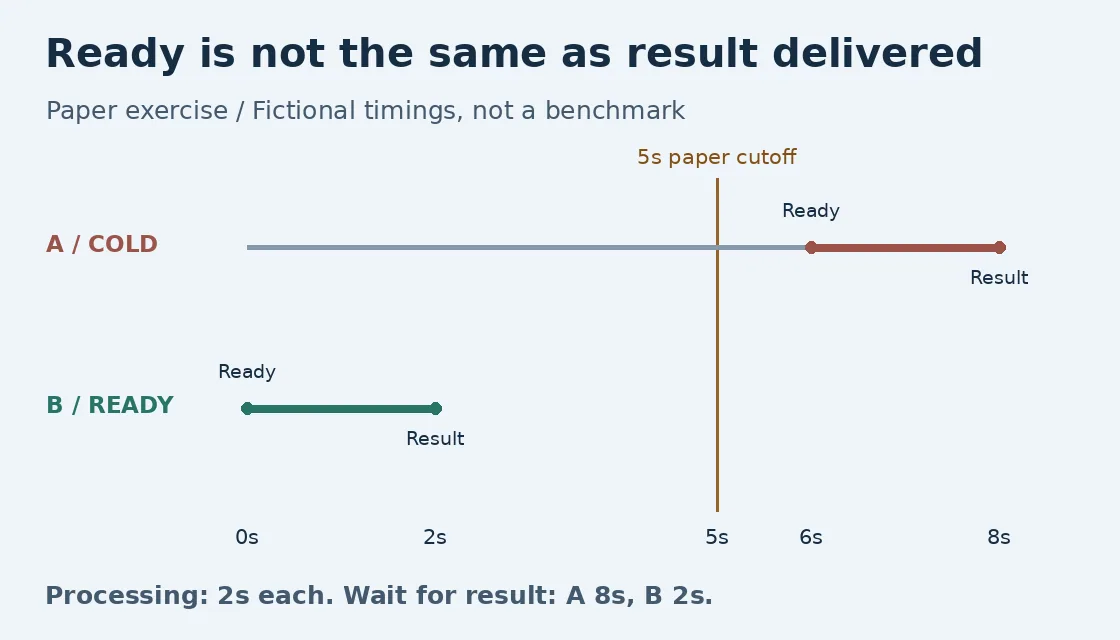
Original paper illustration, not a Cerebrium screenshot or performance test. Only B meets the invented five-second cutoff for a usable result.
Ask a reviewer how long processing takes after readiness and how long each user waits from the request. Processing is two seconds in both; the respective waits are eight and two seconds. With an invented five-second deadline for a usable draft, A fails and B passes. Averaging the two does not pass the cold first request, and “ready” does not count as a result. There is no Cerebrium test, execution, deployment or connection.
When startup need not drive a platform switch
If requests are infrequent and waiting for the first one interrupts work, ask vendors how they separately count the first wait, processing after readiness, usable results and failures. For batch work checked later, where the first result is not the acceptance criterion, prioritize a complete batch delivered on time instead of switching for startup alone.
Content note:This article is based on publicly available information and is intended as a reference for evaluating tools. Features, pricing, and related policies may change at any time; please refer to the latest official information.
Original source:cerebrium.ai