Dubble buying guide: Seeing the button does not prove the step is done
Compare original drawings that locate a control with drawings that let a reader verify the completion mark.
The August 26, 2024 article by Dubble describes editing and cropping images in step-by-step guides; its framing guide shows positioning and zoom. Ask not only whether an image is clear, but whether it points to a control or shows that the step produced a result. These are paper drawings, not screenshots, screen recordings, real work, or private material.
An equally clear crop can still hide the result
Draw two original boards. Both have a square with a dot in the lower left, meaning “use this spot.” Only the second has a triangle at upper right, meaning “done.” Draw crop A around the bottom left of board 1 and B around the bottom left of board 2. Crop C keeps the triangle and a useful orientation mark from the upper right of board 2. A and B show where to act, but neither distinguishes completion. C lets readers check the completion mark, but is not the best view for finding the square.
Put A and B side by side with their titles hidden. Can either crop alone establish completion? No. Then have the reader explain the sequence using A for location and C for result. They do not have to combine them in one image, but should be able to say which question each answers.
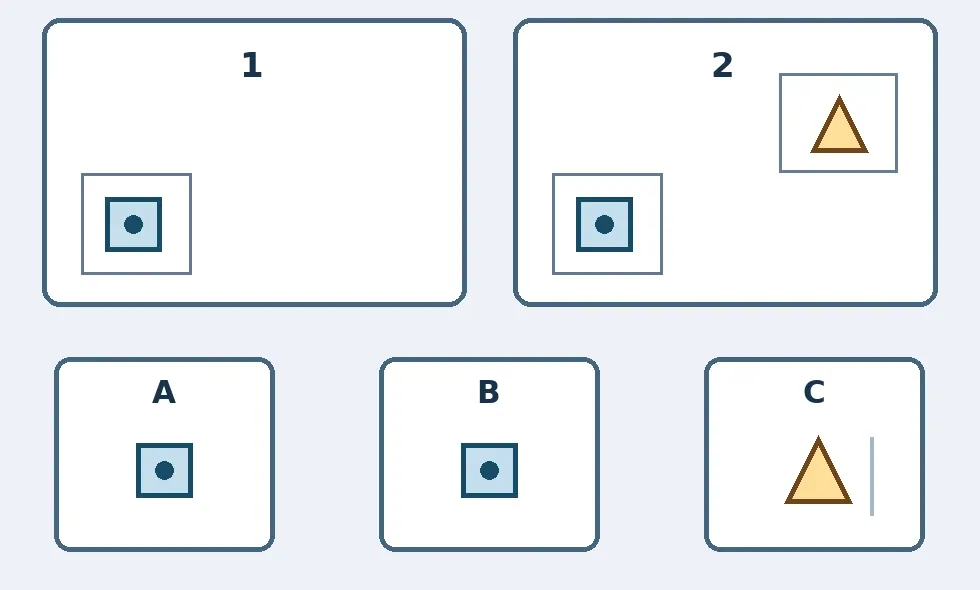
A and B only locate the square. C lets readers check for the completion triangle, not verify the entire process. This is not a product screen.
When is it worth using two kinds of image?
If a step uses a small control and its result appears far away, compare a location close-up plus a result view with one full view. Include the cost of updating several images when the step changes. If the text already identifies the action and success signal unambiguously, images may be unnecessary. Choose based on whether a new reader can verify the same cues, not image count, automation, or zoom. Only self-drawn shapes are used; no tools, apps, accounts, recordings, uploads, or sharing.
Content note:This article is based on publicly available information and is intended as a reference for evaluating tools. Features, pricing, and related policies may change at any time; please refer to the latest official information.
Original source:dubble.so