EbSynth buying guide: Can you still recognize the mark after occlusion?
Original geometric cards show why a keyframe is a reference, not a substitute for checking what reappears.
EbSynth describes carrying a visual edit from one keyframe to other video frames. The authors’ 2019 research provides the historical basis for example-based video stylization. A keyframe shows the appearance to preserve, not which object receives it later. This paper exercise tests no version’s output.
Follow the same mark through three paper frames
Draw a fictional square tile with two short blue lines on its left. In frame 1 the tile is fully visible. In frame 2 a gray bar hides its left side, including the lines. In frame 3 the tile clears the bar, and the lines should reappear on the same tile. The gray bar was never the target. Keep frame 1 as the reference, then draw a wrong frame 3: the tile comes back but the lines stay on the bar. Use no real imagery, videos or third-party material.
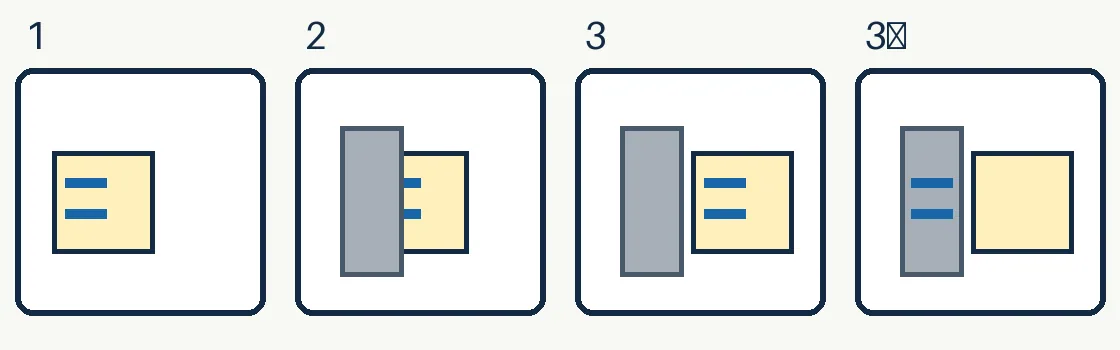
In 1 the lines belong to the tile; 2 hides them. In 3 they reappear on the tile; 3× wrongly leaves them on the gray bar. Not a screenshot.
Ask a reader where the lines belong frame by frame, rather than counting them. In frame 2 they are hidden, not something to add to the bar. Correct frame 3 returns them to the tile; keeping two lines on the bar fails. If the edges of the tile are unclear in frame 3, mark “position to verify,” not “correct” based on frame 1. After occlusion, check that a feature still belongs to the same object.
For just a few frames, manual work may be easier
If a look needs carrying across many frames and you can review occlusion, compare EbSynth’s keyframe approach. For three to five frames, marking the object and feature directly may be clearer. This does not operate software, handle real footage, give technical settings or claim how EbSynth performs on occlusion.
Content note:This article is based on publicly available information and is intended as a reference for evaluating tools. Features, pricing, and related policies may change at any time; please refer to the latest official information.
Original source:dcgi.fel.cvut.cz