Featherless buying guide: Why can three tasks need different concurrency capacity?
When comparing hosted models on Featherless, check your peak concurrency budget and per-model unit cost separately. Monthly request totals and catalog size cannot tell you whether your busiest batch fits.
Doing just a few dozen text tasks a month does not mean the tasks will fit when they arrive together. The plan documentation for Featherless distinguishes a chat plan with a fixed concurrent-unit budget from a developer plan in which model use draws from credits. Also check each candidate model separately: requests to different models may occupy different numbers of concurrent units. When choosing a host, start with which requests need to be in flight together at the busiest time, rather than how many entries the catalog has.
Use four slots to check the same batch of text work
Imagine that a fictional exhibit archive has three short label drafts to prepare at once. Draw four slots as a hypothetical concurrent-unit budget. Make three candidate task cards: two cost one slot each and one costs two. Set them down together: 1 plus 1 plus 2 is exactly 4. Replace the two-slot card with a four-slot candidate. There are still three tasks, but now they need six slots. Even if the one-slot cards go in first, the remaining two slots cannot hold the four-slot card. Letting one task finish first is a separate approach that accepts a wait; it does not mean all three fit at the same time.
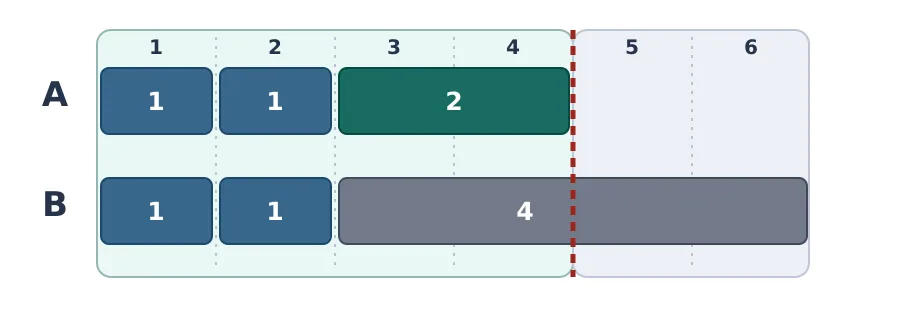
Figure: The four slots left of the dashed line are within budget. The two on the right are outside it. Both groups are paper examples, not plan or model allowances.
For the paper check, write down three things separately: units for each task's model, how many tasks must start together, and which can wait. First check that all the tasks that must run together fit; then see if doing the others in sequence would keep waits acceptable. The exercise only adds up capacity and makes no requests. It makes no claim about actual speed or access to any model. For a real plan, check its limits and the relevant model page rather than assigning the example’s costs to any model.
When is extra concurrency worth paying for?
The hosted catalog is worth comparing if you need different models to work on separate short drafts at the same time and do not want to maintain inference hardware. If you use one fixed model and can work through each batch in order, compare tolerable wait times and the simpler option of running the next task only after the first is done. There is no need to add capacity for an occasional set of three cards. If your inputs cannot go to an external service, rule out hosting first and consider an approved local or internal option. Sufficient concurrency answers the capacity question only. Model quality and commercial billing still need separate checks. Plans may also permit different types of use; enough slots do not imply permission for automated traffic.
Content note:This article is based on publicly available information and is intended as a reference for evaluating tools. Features, pricing, and related policies may change at any time; please refer to the latest official information.
Original source:featherless.ai