Feedpik buying guide: Making room for different sources at the top doesn't remove repeats
To keep the first few reads from all coming from one source, distinguish diversity at the top from complete filtering. Check the ranking boundary with five fictional article cards.
Do you want to see more voices in the first few items, or prevent a source from appearing at all? Feedpik is an option to compare if you want to adjust reading priorities. The official documentation for the public ranking core shows a diversity step that separates items within a per-source cap from those beyond it. The ranking example retains the overflow group rather than deleting its items. This describes the public core's example, not a layout rule every live page necessarily follows.
Check the priority group, then look for what comes later
Put five fictional paper craft article cards in base-score order: A1, A2, A3, B1, C1. A, B, and C identify sources, and each number is local to that source. Set a maximum of two items per source for the paper priority group. Add A1, A2, B1, and C1 in order, and keep the third A card, A3, in the later group instead of tearing it up. That meets the goal if you care only about the first few reads. If the requirement is “A3 must not appear at all,” finding it in the later group means the check fails.
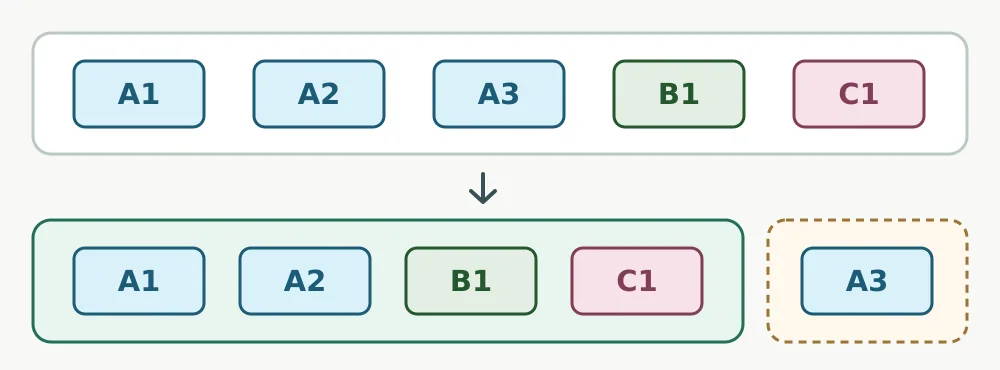
Diagram: A fictional grouping check. Colors and letters identify sources. A3 moved to the later group; it wasn't deleted.
The cards are not actual Feedpik output. Check two things: whether the top has more sources, and which displaced card can still be found later. If a change also replaces some of the candidate sources, finish the comparison on the original set first, so you don't confuse a change in candidates with a change in ranking.
With only a few sources, weights may be unnecessary
If you follow many sources, read only a handful of items each day, and want to control which sources occupy the first slots, make this kind of ranking control a selection criterion. If you follow few sources or need to check all of them for fresh updates, a chronological RSS reader makes it easier to spot anything missing. If certain topics must never appear, verify an explicit filtering rule separately. Caps, weights, and grouping alone don't guarantee exclusion.
Content note:This article is based on publicly available information and is intended as a reference for evaluating tools. Features, pricing, and related policies may change at any time; please refer to the latest official information.
Original source:github.com