Figviz buying guide: The arrow points the right way, but which segment does its number label?
Teaching illustration drafts are useful for exploring layout. Check direction, label association, and reading order along a fictional two-arrow route before deciding whether to draft or draw it yourself.
A clear teaching diagram does not necessarily label the right things. The teaching illustration guide for Figviz calls its output a concept draft to review. You can specify a learning goal and how labels should be placed, but the picture may get the layout, relationships, or scale wrong. It does not validate source data or a real model. It fits when you first want to explore how to lay out an explanation and then check the relationships the picture presents. If the relationship is itself the answer to the exercise, artistic style is not enough to judge the result.
Check which segment a label points to, not just whether all the words are there
Suppose you draw a sample route across a fictional exhibit table, in the order A, B, C. Label the segment from A to B “1” and the segment from B to C “2.” Ask learners to start at B and give the next segment number and destination. The correct drawing lets them follow the arrow to C and read “2.” Another candidate uses the right words and arrow directions, but its leader for “2” ends on A to B and its leader for “1” ends on B to C. Someone reading that diagram will answer “1, to C.” The route still goes the right way; the numbers point to the wrong segments. Both illustrations are hand-drawn examples, not vendor outputs or test results.
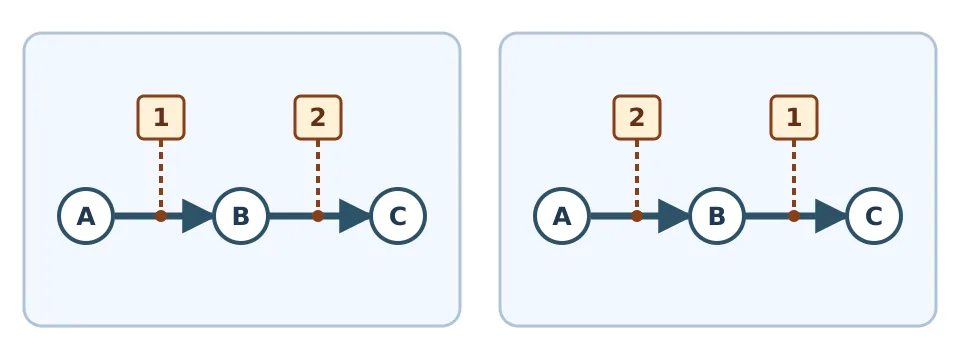
Figure: Checking only that both numbers and arrows are present misses the swapped leaders. Trace the label starting at B, as the question asks.
Give the diagram to a colleague who has not seen the brief. Ask them to name the starting point, the segment to follow, its number, and its endpoint without your help. Then reduce the diagram to the size it will appear in the lesson. If the leaders are only clear when you zoom in, the drawing does not pass. To let someone using a screen reader make the same decision, supply a short text version of the route rather than relying on colors in the picture.
When should you draw it directly, and when is a concept draft useful?
If you are still discussing whether labels belong on the left or right, or how readers should work through the drawing, a Figviz teaching draft is one layout option. For only three points and two segments, placing endpoints and leaders in an editable drawing tool involves less rework. If your deliverable needs exact scale, an editable chart backed by data, or accessible visual and text materials, do not substitute this raster teaching draft for the final deliverable.
Content note:This article is based on publicly available information and is intended as a reference for evaluating tools. Features, pricing, and related policies may change at any time; please refer to the latest official information.
Original source:figviz.com