Flowith buying guide: Continuing an old draft is not the same as rebuilding from two references
An original paper diagram separates preserving the old draft from setting a fresh reference boundary: not every card on the wall is an input.
Flowith's guide to canvas references distinguishes continuing an existing branch from referencing only selected nodes. The former carries forward the branch's existing material; the latter uses what was explicitly selected. This is worth clarifying when several people review the work. What is visible on the canvas and what this task used are two different things.
One wall, two handoffs
Make three fictional exhibit cards. A is the original brief: ‘Use a round mark.’ B is the previous draft: ‘Use a large circle and leave one space on the right.’ C is a new constraint: ‘Body text must fit in two lines.’ To shorten B while keeping its layout, the handoff should trace both A and B; C alone does not establish the right-hand space. To start a fresh design from A and C without inheriting B's placement, explicitly list A and C as references. B does not count just because it is still on the wall.
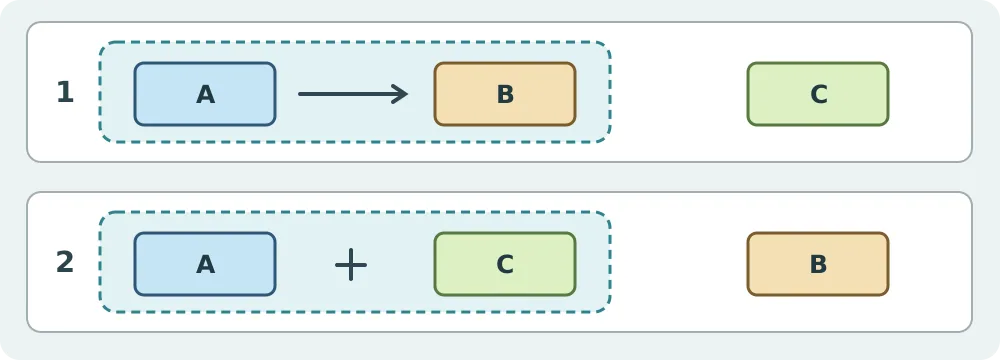
The dashed boundaries differ: seeing B does not mean the second handoff uses it.
Now remove C's source card temporarily, leaving only a ‘two lines’ label. Understanding the restriction does not tell you which card it came from. For acceptance, record the inherited path, the explicit references and any missing source separately. Then check that B's layout has not quietly returned. This example does not suggest that controlling reference scope guarantees a correct result.
When is a visible boundary worth it?
Compare this kind of canvas if multiple contributors frequently switch between older drafts and new references, especially when drafts share a name. A short numbered document is easier to maintain if only a sentence or two is changing and all references fit on one page. Budget time to check references and correct unintended carryover. This example uses hand-drawn paper cards only: no agent runs, sign-ins, real files or content generation.
Content note:This article is based on publicly available information and is intended as a reference for evaluating tools. Features, pricing, and related policies may change at any time; please refer to the latest official information.
Original source:flowith.io