Choosing Foam: A shorter issue list is useful only if distinct faults remain visible
Four fictional ticket errors distinguish removing duplicates from merging faults that need different fixes.
This Foam observes software issues; it is not the note-taking tool of the same name. Its June 18 study describes clustering error text. The reported migration dataset had fewer issues. The study notes that a lower count does not establish that every distinct cause survived, and it did not measure review time.
Use known causes to see why the list shrank
Write four cards for a fictional venue ticket desk. Cards 1 and 2 both say “Ticket printing failed”; both are already labeled as the same roll running out. Card 3 shows the same message but the roll was installed backwards. Card 4 says “Ticket not completed”; it is the same exhausted roll. Grouping by wording yields two groups but mixes causes in one and splits the shared cause. Grouping by remedy also yields two, one for replacing the roll and one for correcting its direction.
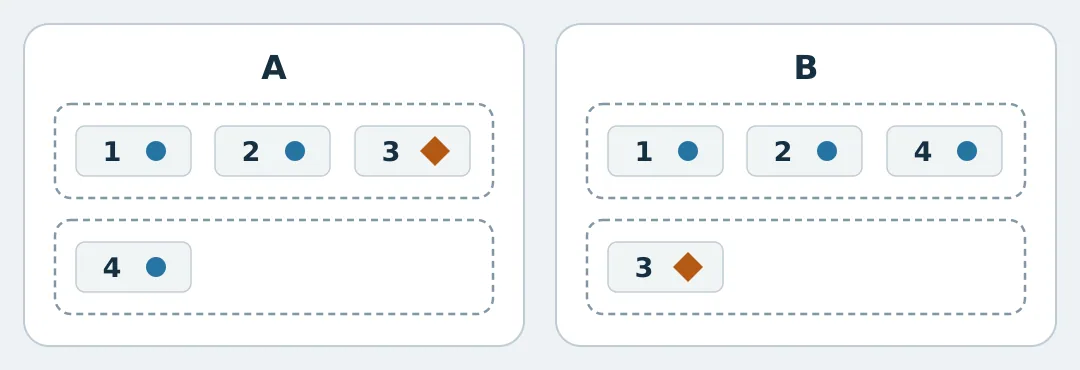
At left, the second group reflects different wording, not a new fault. At right, the fault that needs a different remedy stays separate.
In the paper check, track duplicate groups and mixed groups separately. Preserve one rare example whose cause is known ahead of time. If the shorter list no longer lets you identify it separately, you cannot count every reduction as deduplication. These cards are not test data and do not establish how Foam would group them.
Which teams should compare it?
Consider message-based grouping if repeated alerts cause repeated reviews and independent records let you check distinct causes. If a rare problem is expensive and the evidence for its cause is sparse, define the boundaries manually first; do not switch on group counts alone. Factor in the work to split wrong groups and recheck causes. This paper example does not read system data, connect monitoring or run fixes or automation.
Content note:This article is based on publicly available information and is intended as a reference for evaluating tools. Features, pricing, and related policies may change at any time; please refer to the latest official information.
Original source:foam.ai