GoodMaith buying guide: When you drag a triangle, what changes and what stays fixed?
Use two paper moves, one preserving height and one changing it, to check whether a diagram explains the constraint.
The GoodMaith team description centers teaching on figures that respond when points move. The triangle handbook pairs half of base times height with interactive examples. Consider this approach to show that different outlines can share an area. Check which quantities the diagram displays, not just how smoothly it moves.
Fix the base, move the vertex sideways, then lower it
Draw two triangles on paper with base 8. Their top vertices are 2 and 6 units to the right of the left endpoint and both are at height 3, so both areas are 12 square units. In a third drawing, lower the second vertex by 1 unit without shifting it sideways. The base is still 8, the height is 2 and the area is 8. Equal horizontal positions in the last two drawings do not imply equal areas.
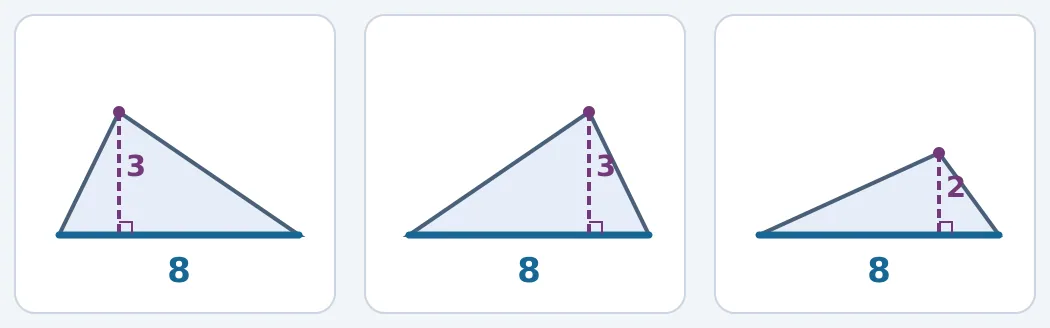
Original diagram: the blue base is 8 throughout, and the purple dashes show perpendicular heights of 3, 3 and 2. Not a product screenshot.
Without seeing area labels, have a second reader identify the fixed base, the sideways move preserving perpendicular height and the later drop. They should calculate 12, 12 and 8. If they notice only changing side lengths or take a sloping edge for height, the diagram fails. The paper example is not a hands-on test of GoodMaith.
When a still diagram or proof is better
To look up a formula, a still drawing with a height line can suffice. To prove it for any triangle, three examples don't replace a derivation. No account or assignments are used; this compares ways of explaining the geometry.
Content note:This article is based on publicly available information and is intended as a reference for evaluating tools. Features, pricing, and related policies may change at any time; please refer to the latest official information.
Original source:www.goodmaith.com