Choosing Artifacts by Samepage: recoverable drafts still need destination checks
Artifacts turns Signals into editable, deliverable product documents. It suits teams with clear fact review and recipient boundaries. Draft rollback should not be treated as a downstream recall guarantee. Evaluate release status, destination versions and the cost of collaboration with at least two seats.
For a product manager turning scattered discussions into release notes, finding the context may take longer than polishing the writing. Artifacts by Samepage uses product information already in Samepage to turn Signals into editable documents and deliver them where the team works. Suitable teams need both approved context and someone responsible for confirming every release fact and recipient boundary. If the material is already organized in one document, maintaining release notes manually may be simpler.
The official launch announcement describes a full editor, improvements or shortening of selected passages, a sidebar Copilot, and version history with rollback for every revision. Finished work can be shared through a public link or sent to Jira, GitHub, Asana, Confluence, email and Slack. This combination makes drafts easy to circulate, shifting the purchase question from writing speed to whether corrections reach the right people accurately. This is analysis of documented features. The materials and versions below are fictional; no real workspace was connected and nothing was sent.
Three signals do not mean three released features
Suppose internal material contains three items: A is available to its intended customers, B has merged code but awaits deployment, and C is only a customer request. Asked merely to write this week’s release notes, even a polished draft could present all three as equally complete. Acceptance should retain each statement’s source item, status confirmer and permitted disclosure scope. Merged code does not make B available, and repetition does not turn C into a commitment. This is a procurement test design, not a claim that Samepage has made these errors.
Context and editing in Artifacts can support questions and revisions, but people still judge facts and audiences separately. An internal product brief can retain B and C as pending; external release notes should contain only confirmed information approved for disclosure. Removing a customer name does not necessarily remove contract details or a private roadmap. Use invented A/B/C items for demonstrations, not real customer meetings or private messages.
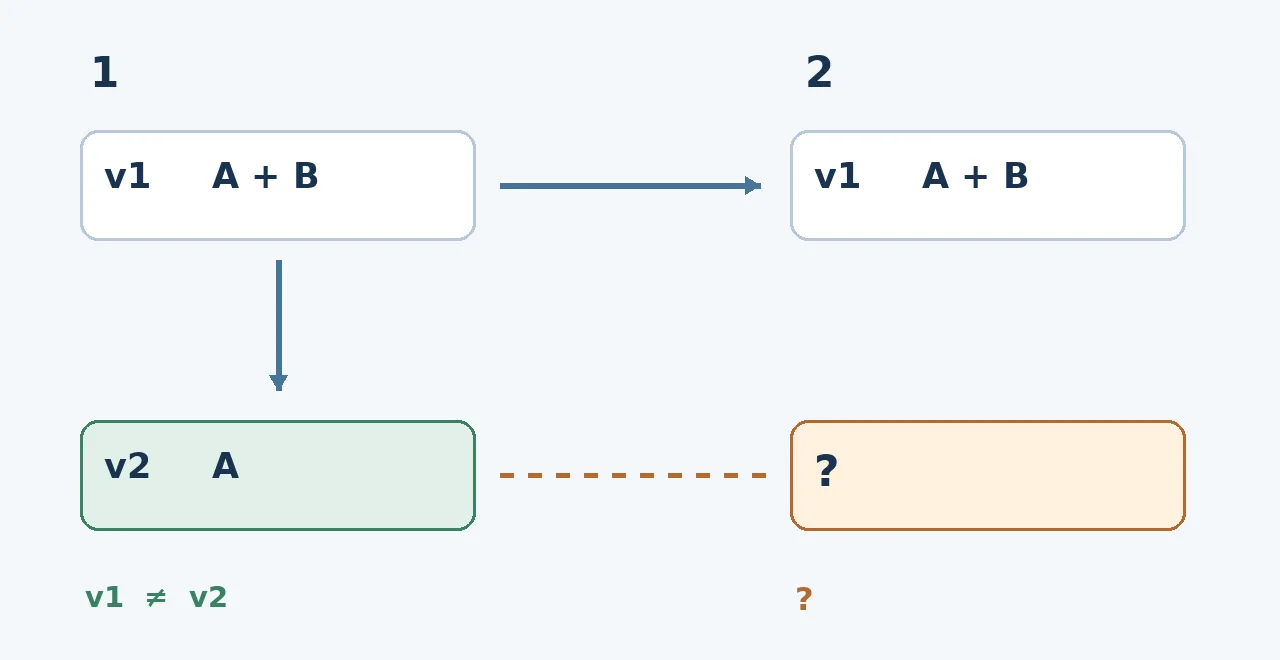
Original fictional illustration: 1 is the editor and 2 the delivery destination. v1 says A and B are available and has been delivered. After B is confirmed not deployed, the editor changes to v2 with A only. The orange dashed line and question mark require a separate destination check; they assert neither automatic updating nor inevitable retention of the old version. This is not a product interface or test result.
Now suppose v1, saying A and B are available, was already delivered to one destination. B is then found not to be deployed, so the editor is corrected to v2, saying only A is available. Version history helps recover or compare drafts, but the announcement’s rollback promise concerns revisions. It does not establish that every downstream message, page or public link rolls back or is recalled with them. A procurement demonstration should check the source version and actual destination content separately, rather than treating a successful editor save as proof of downstream correction.
Clarify redelivery too: does it update the original item or create another copy; does the old link remain valid; who approves and carries out a correction? A local destination log can simulate these outcomes in a demonstration without external sending. If the team requires synchronized destinations and unified recall, ask the vendor to demonstrate behavior for each relevant connector. Without evidence, retain human approval and checking for delivery; do not count unverified synchronization as a purchasing benefit.
Version and collaboration boundaries affect the budget
The official pricing page lists Free with one user, three data sources and 15 artifact generations per month. That supports an individual evaluating a few documents, not proof that two PMs can collaborate in one free workflow. Teams lists collaboration and role permissions at $25 per seat per month billed annually, with a minimum of two seats. At that annual rate, the minimum is $50 monthly equivalent and $600 for the year, not $25 for the whole team. Before contracting, confirm currency, taxes, connector scope and how generations and retries use allowances. Role permissions alone do not establish visibility at every destination.
Keep fact review shared by both methods in the comparison, and count only work actually removed as a benefit. Suppose manually finding material, drafting and delivering the same note takes 40 minutes. Assistance needs eight minutes of context preparation, 17 of checking and editing, and ten of destination-version checks. Net saving is 40−(8+17+10)=5 minutes, with subscription and integration maintenance additional. This is an estimation method, not a product benchmark. Tracking multiple copies after each correction can consume the drafting time saved.
A worthwhile adoption turns the same approved materials into factually correct, audience-appropriate, version-verifiable deliverables faster. Recovering drafts, creating public links and pushing content to tools are separate pieces of that process. Teams writing only occasional notes, lacking a clear reviewer or unable to accept context-connection requirements should retain existing documents and manual delivery first. Paying for document circulation should reduce omissions and rework, not merely add unverified publishing channels.
Content note:This article is based on publicly available information and is intended as a reference for evaluating tools. Features, pricing, and related policies may change at any time; please refer to the latest official information.
Original source:www.samepage.ai