AiGenda can speed up interview review, but repeated mentions in a summary are not more users asking for a feature
AiGenda’s topic summaries, full transcripts and recording playback can reduce time spent finding interview evidence, provided speakers, negation and conditions survive. Test fictional interviews first, then decide whether to pay based on the total cost of the same evidence handoff.
If a product team has accumulated interview recordings but keeps replaying whole conversations to find “who said this?”, AiGenda is worth trying as an organising entry point. Its value should be faster retrieval of verifiable statements, not deciding feature priorities for the team. If existing meeting notes already locate the evidence, or recordings cannot go to an external service, keeping the current note-taking and storage method may be more appropriate than adding another processing step.
The official getting-started guide describes uploading audio or video and producing meeting minutes, topic summaries and a full transcript. A time beside a summary topic jumps back to the corresponding recording segment. Minutes and transcripts can be downloaded as TXT, and summaries as PDF. The specific capability worth testing is this path: locate a topic in the summary, inspect context in the transcript and verify the statement in the recording. Time savings and analysis results in the vendor’s interview story are not results your team has already achieved, and exported text does not automatically replace the original recording.
Preserve the speaker, negation and conditions before aggregating themes
Run a small trial with self-recorded fictional interviews approved for public sharing, without uploading real user or customer information. Give three fictional interviewees stable IDs P1, P2 and P3, identify the interviewer separately, and write the reference statements beforehand: P1 says twice that they need weekly exports; P2 explicitly says they do not need exports; P3 needs them only for audits. There are four topic mentions but only three interviewees with different conditions. This cannot become “four users all ask for export”.
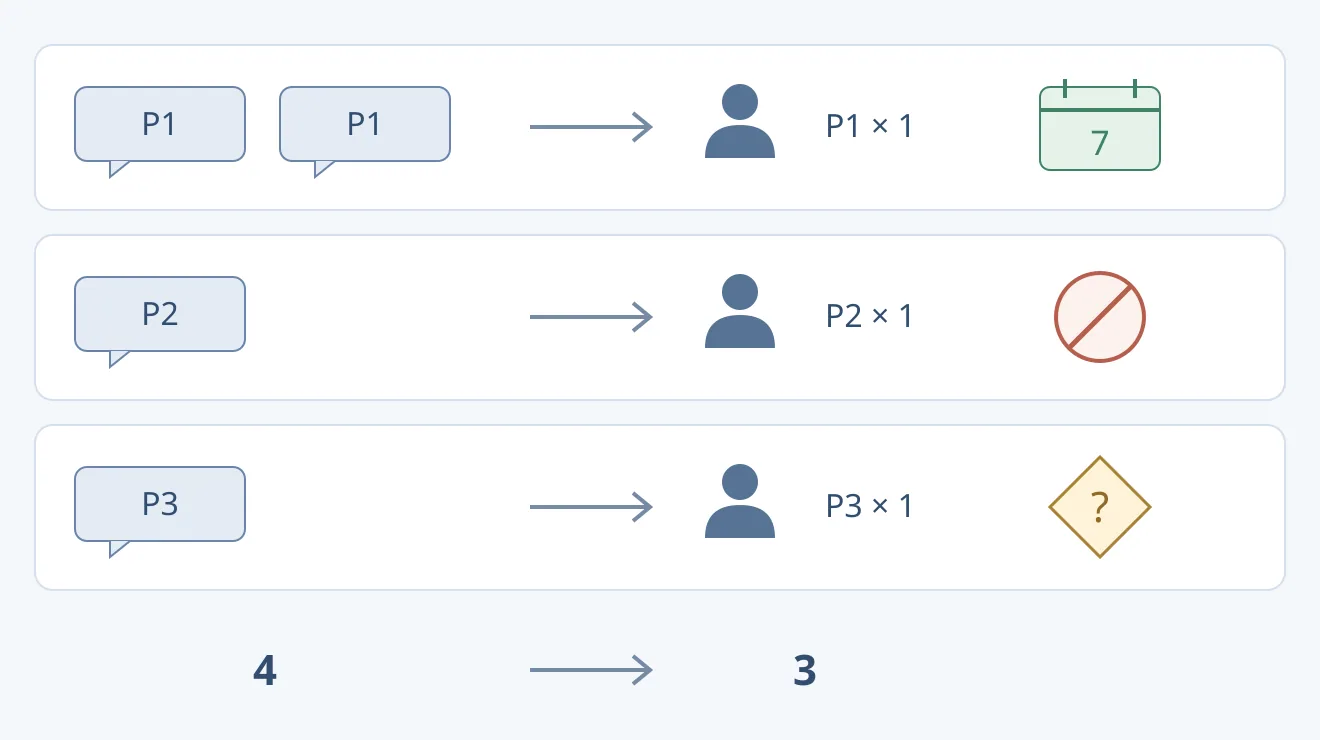
Original fictional interview diagram, not AiGenda output or a measured test. P1’s two statements represent one person; the calendar marked 7 means weekly. P2’s crossed circle means no need, and P3’s question-mark diamond means a need only under the audit condition. The 4 counts mentions and the 3 counts interviewees, not three unconditional votes in favour.
Have the researcher locate those statements through AiGenda’s topic summary, inspect the surrounding transcript, then replay the recording at the indicated time. Check the speaker, negation, frequency and conditions for each one. In particular, do not treat an interviewer’s question as an interviewee’s opinion. A topic timestamp is an entry point for review, not necessarily the exact sentence to quote. Add the precise location and verification result to your own research notes. Even if the transcript is editable, retain an original version or correction history so colleagues can still assess the evidence.
A handoff can separate interviewee ID, statement location, quotation, applicable conditions and researcher interpretation into columns. This is a recommendation for your team, not a claim that AiGenda has this built-in evidence table. P1’s repetition still represents one interviewee; a keyword match must not turn P2’s negation into support; P3’s condition must not become a routine essential need. Even after these distinctions are preserved, the product owner must consider sample provenance, business goals and other evidence before deciding what to build, rather than concluding from mention counts alone.
Before paying, compare the total cost of producing the same evidence record
Use the same fictional recordings and handoff requirements with another method, such as the current media player and manual notes. Separately record upload and processing waits, finding segments, correcting transcripts, confirming speakers and organising quotations, along with any missed negation or conditions. Keep machine waiting time separate from active human work: the recording’s duration is not automatically labour time saved. Adoption requires key meanings to be verifiable and the process, including correction, to be easier than the original method. A faster summary alone is not a pass.
Before formal adoption, run approved sample checks in the team’s actual languages, accents and recording quality, and confirm that the required plan provides editing, exports and sufficient usage. A documented feature is not necessarily included in every tier. Compare the actual plan or additional usage charges with the value of net labour saved. For real material, first confirm recording and upload permissions, retention and deletion conditions, and access scope. The guide describes sharing links that can open access to unregistered people, but easy sharing is not a reason to make interview material public. This pilot needs neither public links nor relaxed meeting-guest permissions.
If the team can quickly return from summaries to original statements, preserve objections and conditions, and reduce the total work of preparing evidence, AiGenda can handle a first organising pass after interviews. If colleagues repeatedly replay recordings to recover omitted qualifications, or sharing boundaries do not meet project requirements, keep the existing workflow for now. It is better suited to helping researchers find evidence than turning unchecked summaries straight into a product roadmap.
Content note:This article is based on publicly available information and is intended as a reference for evaluating tools. Features, pricing, and related policies may change at any time; please refer to the latest official information.
Original source:aigenda.tech