Anam buying guide: When is a video enough for the same avatar?
Text or a scripted MP4 can deliver a fixed welcome. Evaluate an Anam live avatar only when a visitor’s clarification changes the next step, and test unknown answers, microphone refusal, and ongoing costs.
Before putting a welcome character on a webpage, ask whether visitors will get different directions after telling it more. If everyone needs the same opening instructions, a text page may already be enough. If consistent audio and visuals are necessary, compare Anam’s scripted video. Consider a live version of the same character only when clarification genuinely changes the next step and dependable routing rules already exist.
Reusing a persona does not reuse its conversation
Anam’s Avatar Videos API asynchronously renders a submitted script to a downloadable MP4 without starting an interactive session. Choose the avatar and voice directly or reuse a saved persona. In the latter case, the video inherits the avatar, voice, language, avatar model, and director notes. It speaks only the submitted script and does not run the persona’s greeting, conversation model, prompt, or tools. Even if the saved persona usually asks which event the visitor is attending, the video will not ask on its own. Editors should put essential information explicitly in the script and provide standalone written directions.
Imagine an entirely fictional venue. If its site only needs to say “Check the event schedule first, then follow its entry directions,” text and a scripted MP4 can give everyone the same information. If a visitor asks how to get to Hall C and the approved example rules say to use the east entrance for day events and the south entrance for evening events, the follow-up “Which event are you attending?” changes the directions. If the visitor is unsure or the question falls outside the rules, offer the same schedule instead of guessing an entrance. The venue, rules, persona, and voice are designed to be fictional and synthetic, without imitating real people. This is a proposed acceptance scenario, not a measured result.
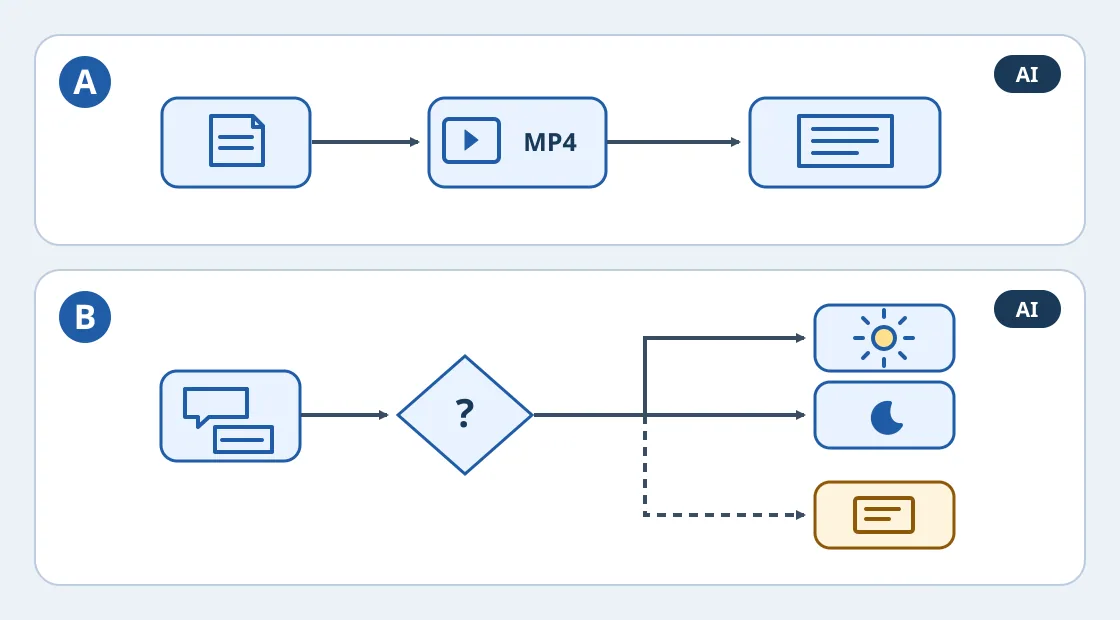
Original buying-test diagram, not the Anam interface or a test result. A presents a fixed script with the same fictional persona; reusing its appearance and voice does not run its conversation model or tools. B considers live interaction only when a clarification changes the next step, with text as a fallback. Both routes should clearly disclose AI. The text icon at the end of A represents directions prepared separately by the team on the same page, not text automatically generated by the MP4.
Compare the live option with text-based routing in the same test
Start with a baseline without an avatar: give visitors two clear options on one text page so they can choose day or evening. Compare it with the proposed scripted video and live options. Check whether fixed information can be read or heard on the same page, whether a clarification produces the right branch, and whether the system acknowledges an out-of-scope question and falls back to text. Written directions should remain available when the visitor declines microphone access, sound is unavailable, or the session fails to connect. Measure time from opening the page to getting correct directions, not time to first video frame. If two text choices handle routing reliably, there is no need to maintain live sessions for the same result.
Also check whether visitors know they are dealing with AI. Anam’s release notes distinguish its own experiences from custom integrations: Lab sessions and share links include persistent AI disclosure, while JavaScript SDK, Python SDK, and LiveKit integrations can opt in to Anam’s label. Do not assume a custom interface already displays it. Clear AI disclosure and a text link before and after a scripted video are acceptance criteria here, not verified MP4 defaults. Validate in a separately approved demonstration with fictional input only, without connecting real lists, accounts, or tools that act externally. The fact that scripted video does not run persona tools does not show that live sessions are inherently isolated.
Compare full costs for the same set of visitors
First ask who will update directions. When the schedule changes, plain text can be edited on the existing page. Fixed video may require script edits, rerendering, replacing the video, and checking captions. A live deployment still needs rule updates plus a review of session usage, concurrency limits, integration, and ongoing checks. Ask the vendor separately how rendering, reruns, and sessions are billed. Do not treat finished-video duration and session minutes as a single billing item. Use the same hypothetical visitors and instructions to compare maintenance and running costs for getting people to the correct result, rather than comparing which avatar looks more conversational.
Set a clear purchasing threshold. Use maintainable text for fixed content and make a scripted MP4 only when consistent audiovisual delivery matters. Consider live interaction in the next round only if clarification reduces wrong directions and text-based routing cannot do it as reliably. If failures do not fall back to text, AI disclosure is hard to see, or full costs are unclear, keep the simpler option.
Content note:This article is based on publicly available information and is intended as a reference for evaluating tools. Features, pricing, and related policies may change at any time; please refer to the latest official information.
Original source:anam.ai