Is Asana AI summarization worth using? Check that rejected proposals stay rejected
Asana Smart summaries can extract highlights from task descriptions and comments, but a proposal being mentioned is not approval. A fictional exhibition task tests proposals, later rejection and remaining work to assess whether summaries really reduce handoff verification cost.
When task comments run long, the next owner does not need every sentence shortened. They need to know what remains to be done and which plans were abandoned. Asana Smart summaries is worth assessing when the relevant discussion already lives in task descriptions and comments, and the team repeatedly spends time finding action items. If actual decisions are scattered elsewhere, completing the record matters more than generating a fluent summary of incomplete material.
Asana's official announcement identifies task descriptions, comments and key action items as the scope of Smart summaries. The task-summary help page describes a preview that can be discarded, copied or edited, with a person then deciding whether to post it as a comment. Treat this as reading and handoff assistance, not a new source of approval. This article does not bundle project recaps, meeting transcription or automatic execution into the verified capabilities of task summarization.
A discussed proposal is not necessarily still valid
Imagine a wholly fictional exhibition-material task whose description says “Prepare the venue poster.” Comment C1 proposes: “We could print 200 extra copies and have them delivered Friday.” C2 later states: “The extra-printing proposal is rejected. Use existing stock only; Friday is just for checking whether stock is sufficient.” C3 adds: “If stock is insufficient, submit an alternative for review first. Do not print extra copies directly.” These are self-made acceptance materials, not client conversations, and were not sent to Asana.
A sound handoff retains three things: no extra printing is a decided constraint; Friday's stock check remains actionable; and insufficient stock requires an alternative proposal followed by review. A summary saying only “Print 200 extra copies Friday” revives a proposal as an action. One saying only “Extra printing was rejected” loses the stock check and conditional branch. The issue is not compression into one sentence, but whether the state, timing and conditions of each action remain traceable to the original comments.
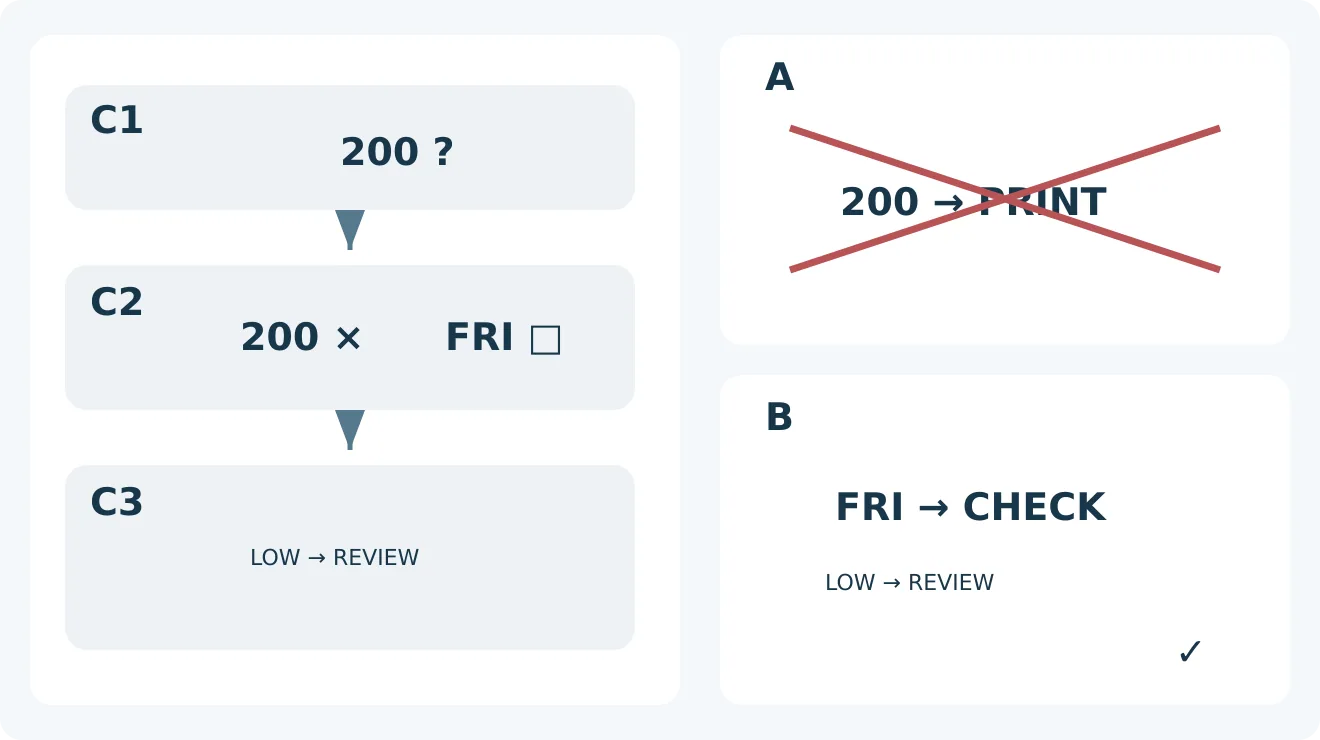
Original acceptance illustration, not Asana output or a test result. C1 is a proposal; C2 rejects extra printing but retains Friday’s check; C3 requires an alternative to be reviewed if stock is insufficient. A sound handoff preserves valid actions and conditions, not every verb. The rejected quantity 200 must not enter the execution list. FRI means Friday, CHECK the stock check, LOW insufficient stock, and REVIEW prior review of an alternative.
Before buying, compare a manual handoff note with the proposed summary workflow using the same self-made material. Establish the reference answer first, then check whether both outputs preserve C2's rejection, C3's condition and the fact that C1's quantity was not adopted. Report-like writing is not correctness, and passing this small case is not an accuracy rate for all comments. This article did not run the product. Both good and bad outputs in the illustration were written to explain acceptance criteria.
Include review and record completion in summarization cost
A reviewer needs to trace each action back to its original description or comment, checking who proposed it, when, and whether it was later corrected. You can record references such as C1, C2 and C3 in your own acceptance sheet, but that does not establish that the product automatically provides those same markers or guarantees complete citations. If the record contains no final decision, the result should retain “Awaiting confirmation,” not turn the latest ambiguous opinion into approval. A comment's author may not have approval authority either; check the team's actual rules separately.
Use fictional tasks without personal information in the pilot, and have an administrator confirm the applicable plan, AI settings and permitted data scope. Seeing a summary button does not imply that any information can be submitted. After human review, posting a comment, creating subtasks or notifying others still follows existing permission and confirmation procedures. Reading a summary does not authorize subsequent actions. This article connected no workspace, entered no real comments and sent no notifications.
Finally, compare total cost for the same usable handoff: manual reading and organization versus generation wait, item-by-item verification, corrections and time filling in missing decisions, plus any additional plan or seat fees. If most tasks are short, or correcting a summary takes longer than reading the source, keep the manual approach. Expand use only if long comment threads are frequent, source records are complete and the reviewed handoff saves total effort. The goal is to miss fewer real actions, not turn unapproved ideas into tasks faster.
Content note:This article is based on publicly available information and is intended as a reference for evaluating tools. Features, pricing, and related policies may change at any time; please refer to the latest official information.
Original source:investors.asana.com