Astute buying guide: compare more than service fees and audience counts
Use the same fictional B2B brief to compare in-house execution with Astute. Separate platform fees, creator placement fees and internal review time, then check overlap and what can actually be verified across a newsletter and a podcast.
A B2B software marketing team wants to promote a public inventory-count template and bring more warehouse operations staff to its download page. The team knows whom it wants to reach, but it hasn't found suitable creators yet. If every campaign means starting over on research, scheduling, briefing and chasing assets, Astute is worth comparing. If the team already has two suitable partners and only needs a brief and a delivery check, an internal checklist may be enough. The buying decision turns on how much coordination Astute can take off the team's hands without weakening its judgment about content, costs or results.
Astute's launch materials describe a B2B new-media partnership platform covering channels such as newsletters and podcasts. In the launch Q&A, cofounder Vida Stanic separated two costs: if a creator charges a fee, the brand pays it separately, and the subscription covers services such as sourcing, matching, communications, administration and payment handling. Handling payouts doesn't mean the creator is paid out of the subscription fee. A platform-only quote is therefore incomplete: ask the vendor to list placement fees, platform services, possible extras and billing periods separately. The launch materials establish the operating model, not the audience quality of particular candidates or the inclusion of every task in a given plan.
Hold the deliverables constant when comparing quotes
Keep the fictional brief to two deliverables. The first is a sponsored item in a warehouse operations newsletter linking to the download page. The second is a sponsored read on a podcast for operations leads, with a separately tagged link in the show notes to the same destination. Both should clearly disclose the sponsorship, and the creator should retain appropriate editorial independence. Before making any commitment, the team should establish the evidence for audience fit, where and when the items will appear, permitted reuse, how a missed or delayed placement is handled and who approves the final copy. Keep both deliverables the same on both procurement paths. A cheaper newsletter-only proposal isn't comparable to a package that delivers both. Similarly, treating the spoken read as the clickable link misstates where people can actually click.
Suppose both routes use the same budget units and the creator fees come to 900. In-house execution takes eight hours at 50 per hour, for a paper cost of 1,300. The platform route still takes three hours of internal review, making it 1,050 plus the service fee. Leaving out taxes and any other common costs, the routes break even if that fee is 250. If the same quote adds a separate coordination charge of 80, the acceptable service fee falls to 170. These figures are invented budget units, not Astute prices or measured time savings. If the team has no valuable use for the five hours it would save, 250 shouldn't automatically become its willingness to pay.
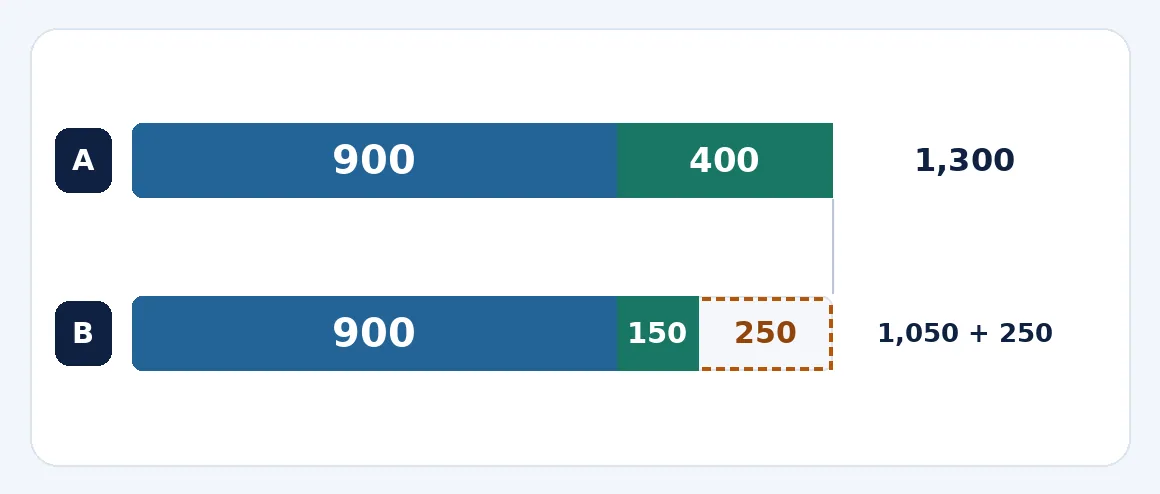
Original paper example. A is in-house execution; B is the platform route. Both start with the same 900 in creator placement fees, then add 400 or 150 in internal labor. The dashed 250 segment on B is the break-even threshold before any extra charges, not Astute pricing.
Don't add incompatible audience figures
Suppose the newsletter lists 6,000 subscribers and the podcast averages 4,000 downloads per episode for a recent run of shows. One number describes a mailing list and the other counts downloads. The units are different, and the overlap between audiences is unknown. They don't add up to 10,000 unique people reached, much less an estimate of sales. A smaller outlet may have a better fit: a podcast mainly heard by warehouse operations staff and willing to keep a link in its show notes may suit this brief better than a much larger general startup show. Ask for sample placements and the definitions, time windows and sources behind the reported audience figures. An audience claim without a source isn't a guarantee.
In a paper demonstration, ask the vendor to fill out a delivery sheet for each fictional placement. The newsletter needs proof of sending or a public page. The podcast needs an episode URL, the timestamp of the read and the link in the show notes. With different tags on the two links, the team can use its own download page to distinguish visits or downloads arriving through each link. Someone who hears the read and searches for the page independently may not be attributable to the podcast, and shouldn't be assigned to it by default. Check the actual placement and clickable links before reviewing the predefined download event. If the page is accessible from other channels, the resulting counts describe observable paths; they don't establish how much new demand the sponsorship caused. The example involves no real account connection, creator contact, booking or publication.
Rather than expanding the campaign first, ask for an Astute plan and an in-house plan of equal scope. Each should show the two deliverables, itemized costs, the work the team retains and evidence it can use at sign-off. Astute belongs on the shortlist if the suggested creators fit the target roles better, the coordination time saved is worth something, and the team retains control of approval and acceptance. If the quote combines placement and service fees, the audience numbers aren't comparable or the main obstacle is that the team still hasn't defined its audience and success criteria, it will get more from clarifying the brief and its existing partnerships than from paying for a longer shortlist.
Content note:This article is based on publicly available information and is intended as a reference for evaluating tools. Features, pricing, and related policies may change at any time; please refer to the latest official information.
Original source:web.archive.org