Choosing Avoma: should “I’ll do it” become an assigned action item?
Test three fictional meeting notes to see whether Avoma helps distinguish confirmed work from commitments that need clarification.
If several meetings each week leave your team sorting follow-ups, compare Avoma with manual notes. A small number of meetings or an established record that already specifies who delivers what and when may not justify another tool. Avoma’s 2024 update introduced AI meeting takeaways, and its official help includes follow-up items in notes and recommends completing owners and deadlines by hand. That gives reviewers a starting point; an extracted item is not proof anyone committed.
Use three synthetic notes to check what can be assigned
Use participant IDs, not real people. A: P1 says “I’ll update the example instructions by Friday,” then a read-back confirms it. The draft handoff should preserve the action, P1 and date, ready for human approval. B only says “I’ll do it,” with no speaker label and two earlier topics. Mark it for clarification; do not guess the owner, action or date. C: “If the draft passes, we can consider organizing the checklist next week” is conditional discussion, not scheduled work. Copying the previous speaker into B or turning next week into C’s deadline both fail.
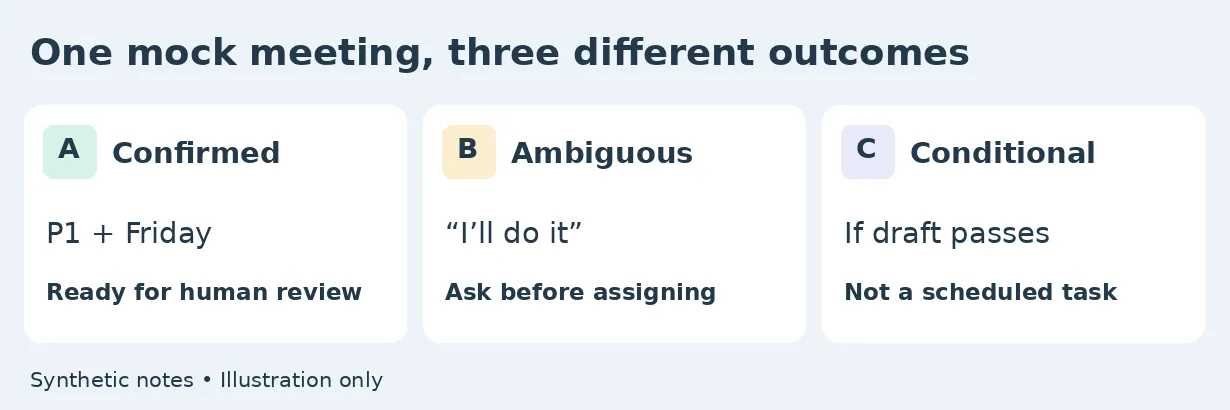
Synthetic acceptance example, not Avoma UI or results. A summary must not guess an unconfirmed owner, deadline or condition.
Define the recording boundary first
Keep the synthetic source and three expected rows. Check whether the tool distinguishes confirmed, unclear and conditional items, then whether each can be verified against the source. If the trial cannot stay inside your agreed boundary, ask the vendor what trial options it supports. Do not supply real recordings or documents to fill a sample. No account was connected and no recording, product use, task creation or sending occurred. Before deployment, an authorized person should define participant notice and consent, permitted retention and duration, who may view or export, and how corrections are handled. Do not grant automatic summaries permission to send, create tasks or update customer records. Actual handoffs need separate human review and team approval.
Include the time to reread, correct misassignments, verify permissions and edit the handoff before comparing with manual minutes. Generation speed is not the total benefit. Expand only if savings persist, ownership can be verified, and retention and access rules are enforceable; otherwise keep manual notes or an approved tool.
Content note:This article is based on publicly available information and is intended as a reference for evaluating tools. Features, pricing, and related policies may change at any time; please refer to the latest official information.
Original source:www.avoma.com