Choosing Blanc Browser: With fewer labels, can you get right back to the page you were reading?
Use static page cards to assess whether Blanc’s Island and tab switching suit long reads and identify any indispensable extension.
If you mainly read long articles on desktop and only occasionally go back to a reference, Blanc Browser puts many tab actions in one small area. The official repository already documented two Island states before September 12: collapsed, it uses dots for directly available tabs and a count for ones not shown; expanded, it exposes the address field and a tab switcher. Removing the permanent tab strip leaves more room for the article, but you no longer have a row of full titles to identify background pages. This is based on official documentation, not a hands-on test.
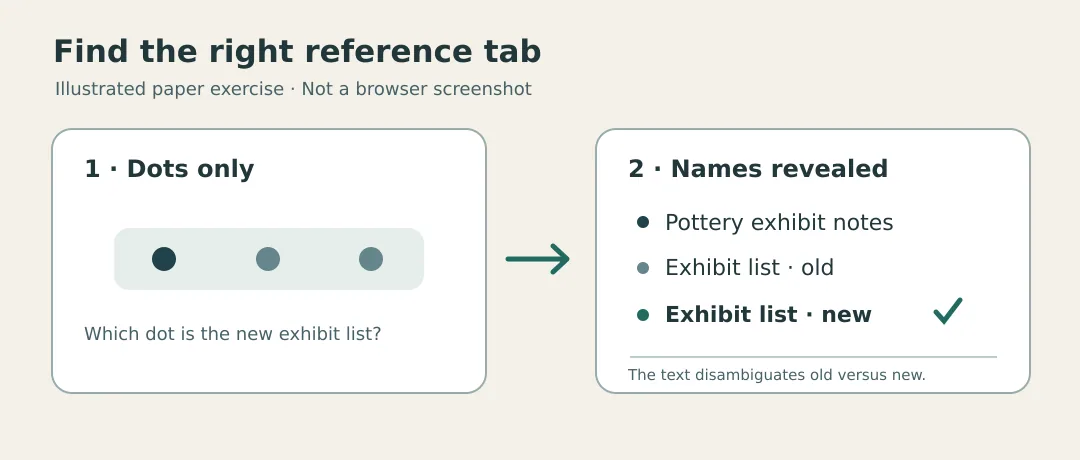
Use three homemade static paper cards; no installation or connected account. Name the main card ‘Pottery exhibit notes’ and the other two ‘Exhibit list · old’ and ‘Exhibit list · new.’ Start with only the tab dots visible; then reveal the card with the names, find the new list, check a made-up item number, and return to the same paragraph on the main card. Don’t grade this by a benchmark: if opening the list once lets you identify the right page and return without losing your place, the simpler interface may suit you. If you keep choosing the wrong version, persistent tab titles are more helpful.
One limitation changes the choice: the repository for that version explicitly states that it does not support general-purpose Chrome extensions. If your team’s terminology tool is available only as a browser extension, leave the work that depends on it where it is. Keep your usual browser for work and consider Blanc for long reads rather than migrating everything for a uniform interface.
Content note:This article is based on publicly available information and is intended as a reference for evaluating tools. Features, pricing, and related policies may change at any time; please refer to the latest official information.
Original source:github.com