Brainfish guide: When someone says “the card won’t open,” what should the help center ask?
Use two original help notes to check whether a match actually applies. First distinguish a drawer for paper cards from a web reference card.
Conversational search doesn’t identify the object by itself
Brainfish’s January 2026 update described conversational search and inline answers in its Help Center Agent. The June update said its help center could handle longer, multipart questions. Compared with a list of article titles, a conversational entry is worth considering because readers can add missing information and see whether the resulting help applies. Neither update proves it always asks a follow-up or identifies the intended object on its own.
Put one phrase against two invented help notes
Write two short notes for a fictional exhibition. The first only applies to a drawer of paper cards at the exhibit stand: “Pull gently from the side marked ‘Pull’; if it sticks, ask staff.” The second only applies to the exhibition website’s reference card: “Open the References list, then select the card title.” The question just says “The card won’t open.” Both titles could match, but you can’t tell which source applies. Ask, “Do you mean the drawer with paper cards at the stand, or the reference card on the exhibition website?” There’s no need to guess an action first.
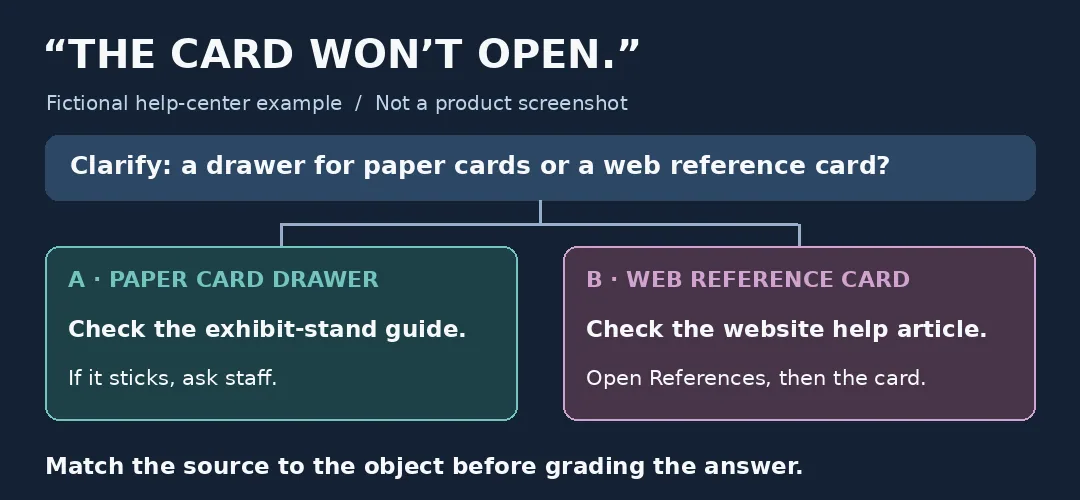
One phrase can match both articles. Clarify the item and check where the source applies. Original paper example, not a product screenshot.
Check the original source’s scope before grading
In a paper exercise, start with the same short question and then add either “the stand drawer” or “the web reference card.” At the first step, a question that clarifies the item passes. A direct recommendation to pull or select a title fails, even if it appears in a help note. After the clarification, a reviewer reads the corresponding original note to verify the object and limitations. Asking staff when the drawer sticks belongs only to the physical drawer, not the web card. A response passes only if it applies to the clarified item. No help center was connected, no message was sent, and no real material was used. This is not a Brainfish test.
When rewriting the help notes is the better first step
If your help center covers several products or pages with overlapping terms, and readers often ask short questions, Brainfish’s conversational entry is worth evaluating if the team has clear sources it can check. If the two pages don’t explain their own scopes, revise the titles and first paragraphs to state what each applies to, and use a simple index if needed. Adding an answer layer can’t supply missing conditions.
Content note:This article is based on publicly available information and is intended as a reference for evaluating tools. Features, pricing, and related policies may change at any time; please refer to the latest official information.
Original source:www.brainfishai.com