Deepgram buying guide: Can a segment timestamp locate an individual word?
Compare two kinds of transcript timing: one takes you to a segment, while the other can show which occurrence of a word falls after a cutoff.
Deepgram distinguishes segments with start and end times from optional word-level timing in its September 22, 2025 article. A segment gives you a broad range; word timing gives you a finer point of reference. This guide compares what those two kinds of annotation let a reader verify. It uses no audio or product output, does not evaluate transcription accuracy, and does not infer that every word can be timed accurately.
The same text: two paper cards answer different questions
Write three fictional labels on paper: “blue tile / bend / blue tile.” Card A marks just the segment, 00:08–00:16. Card B also lists three word slots: 00:09–00:10, 00:11–00:12, and 00:14–00:15. Put a cutoff at 00:13. These are invented times, not measurements from a file, waveform, or device. Both cards point to 00:08 if you only ask where to start reviewing the segment. Only B locates the second blue tile when you ask which occurrence comes after the cutoff.
Now cover the last word’s time on B, leaving the text and the 00:16 segment end. You still know the second blue tile comes later in the text, but neither that order nor the segment end proves it falls after 00:13. Do not fill the gap with another word’s time. Mark it “position unverified.”
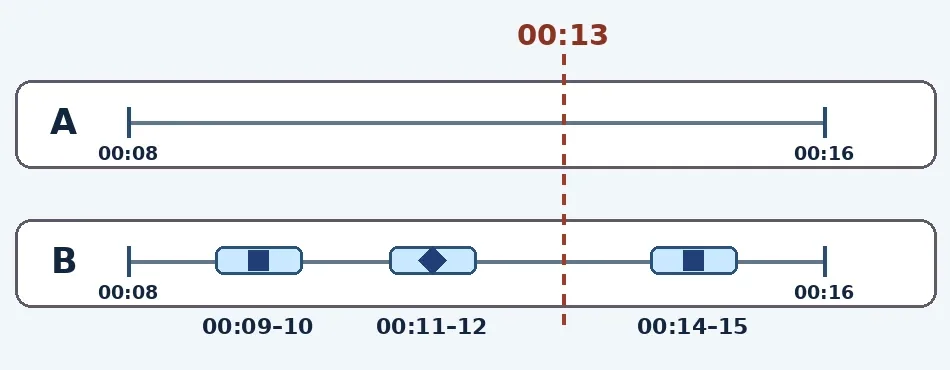
The two cards span the same interval. The upper card locates the segment; the lower card shows the second square after 00:13. Hide its word time and text order alone no longer tells you which side of the cutoff it falls on. Squares stand for the invented label “blue tile”; this is not audio.
When is more detailed timing worth keeping?
If readers only browse by segment, a segment range is usually easier to read and maintain. If you must locate a repeated word or verify which side of a cutoff it lands on, look for checkable word times and clear indications of missing values. Count the time you will spend reviewing them by hand. Word timing is a finer clue, not a guarantee of accuracy. This example uses fictional written labels and timing cards only: no tool, account, recording, playback, or real record.
Content note:This article is based on publicly available information and is intended as a reference for evaluating tools. Features, pricing, and related policies may change at any time; please refer to the latest official information.
Original source:deepgram.com