Deepgram
Voice AI APIs for live and batch transcription, speech generation, audio analysis, and conversational agents.
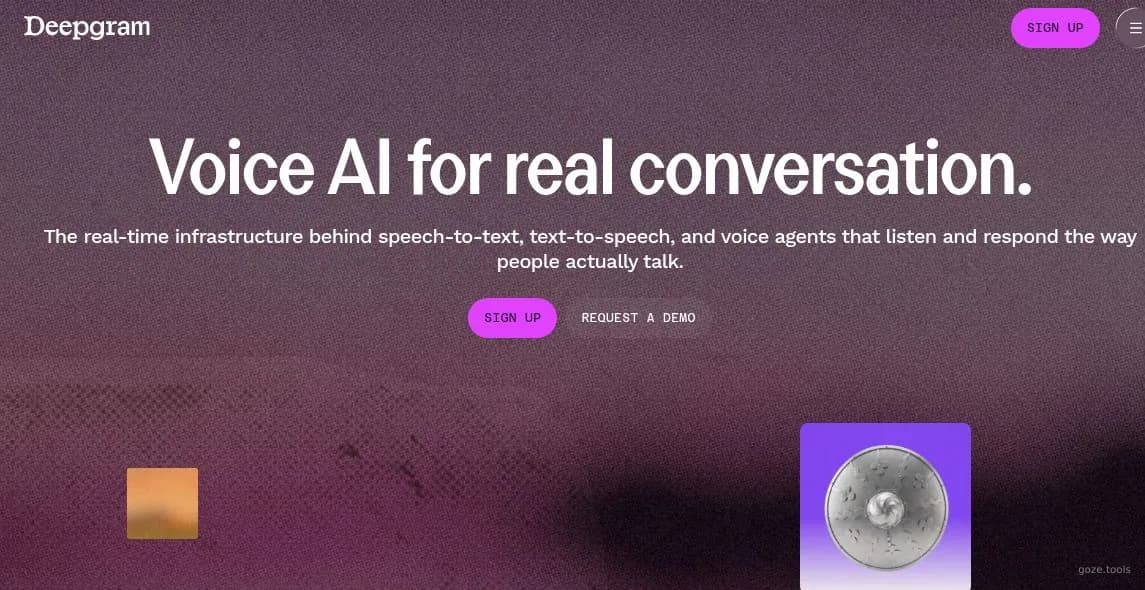
Deepgram voice AI platform overview
About Deepgram
Deepgram is a voice AI API platform for developers who need transcription, speech synthesis, conversational agents, or audio analysis inside their products. Speech-to-text works with live streams and recorded audio. Flux focuses on conversational turn detection, Nova-3 on transcription, and Aura-2 on streaming text-to-speech. The Voice Agent API connects listening and speaking in one workflow. Teams can begin with public cloud endpoints or assess self-hosted deployment when infrastructure control matters. New accounts receive a $200 usage credit; pay-as-you-go charges follow once it is used. That makes early testing accessible, but production planning still requires care. Concurrency varies by endpoint and API type, costs depend on model choice and workload, and some deployment or support requirements may need an enterprise agreement.
Best for
Best use cases
Prototype with the initial usage credit
Scale real-time or batch speech processing
Discuss enterprise deployment and support needs
Compare before choosing
Usage billing avoids a recurring seat fee
Concurrency limits vary across REST, WebSocket, and product endpoints
Enterprise requirements may need a negotiated plan
Features
Live transcription
Convert live calls, meetings, podcasts, or media streams into searchable text as audio arrives, or submit recordings for batch processing. Product teams can use the transcript for captions, searchable archives, agent-assist screens, analytics, and downstream automation. Before production, they should select the appropriate recognition model and API transport, then size capacity against the concurrency limit for that endpoint.
Conversational voice agents
Combine conversational speech recognition, turn detection, and generated speech to build voice assistants for customer support and service workflows. Flux can help determine when a speaker has finished, while the Voice Agent API and text-to-speech components support the response path. Keeping these speech functions on one platform can reduce integration work, but teams still need to test latency, interruption handling, language coverage, and concurrency with realistic calls.
Audio intelligence
Extract topics, summaries, sentiment signals, and other structured information from conversational audio alongside the transcript. Contact centers can route the output into quality review and customer-experience analysis, while research teams can organize large collections of interviews or calls. The resulting signals should feed an existing review or reporting workflow, with human checks where automated interpretation could affect customers or operational decisions.
Speech generation
Stream synthetic speech for customer support, sales, healthcare, and finance applications that need spoken responses during a live exchange. Teams can audition voices in the playground, connect Aura-2 through REST or WebSocket APIs, and measure whether delivery latency suits their interaction design. Production evaluation should also cover voice and language fit, workload volume, endpoint concurrency, and the usage cost of expected response lengths.
Pros
- The $200 starting credit lowers the cost of testing an integration before usage billing begins.
- Speech-to-text, text-to-speech, voice agents, and audio intelligence can share one vendor workflow.
- Real-time, batch, cloud, and self-hosted options cover a broad range of deployment patterns.
Cons
- There is no ongoing free plan; charges begin after the initial $200 usage credit is consumed.
- Concurrency limits differ by REST, WebSocket, Whisper Cloud, and product endpoint, so capacity planning takes care.
- Model and workload choices affect the final bill, and enterprise deployment needs may require sales discussions.
Pricing Plans
Pay As You Go
- No minimum commitment
- Credit does not expire
- No credit card required to start
- Access to public-model endpoints
* Pricing information is for reference only. Please refer to the latest announcement on Deepgram's official website.