OpenAI Codex
A repository-aware coding agent for implementation, debugging, refactoring, and review across command-line, editor, desktop, web, and cloud workflows.
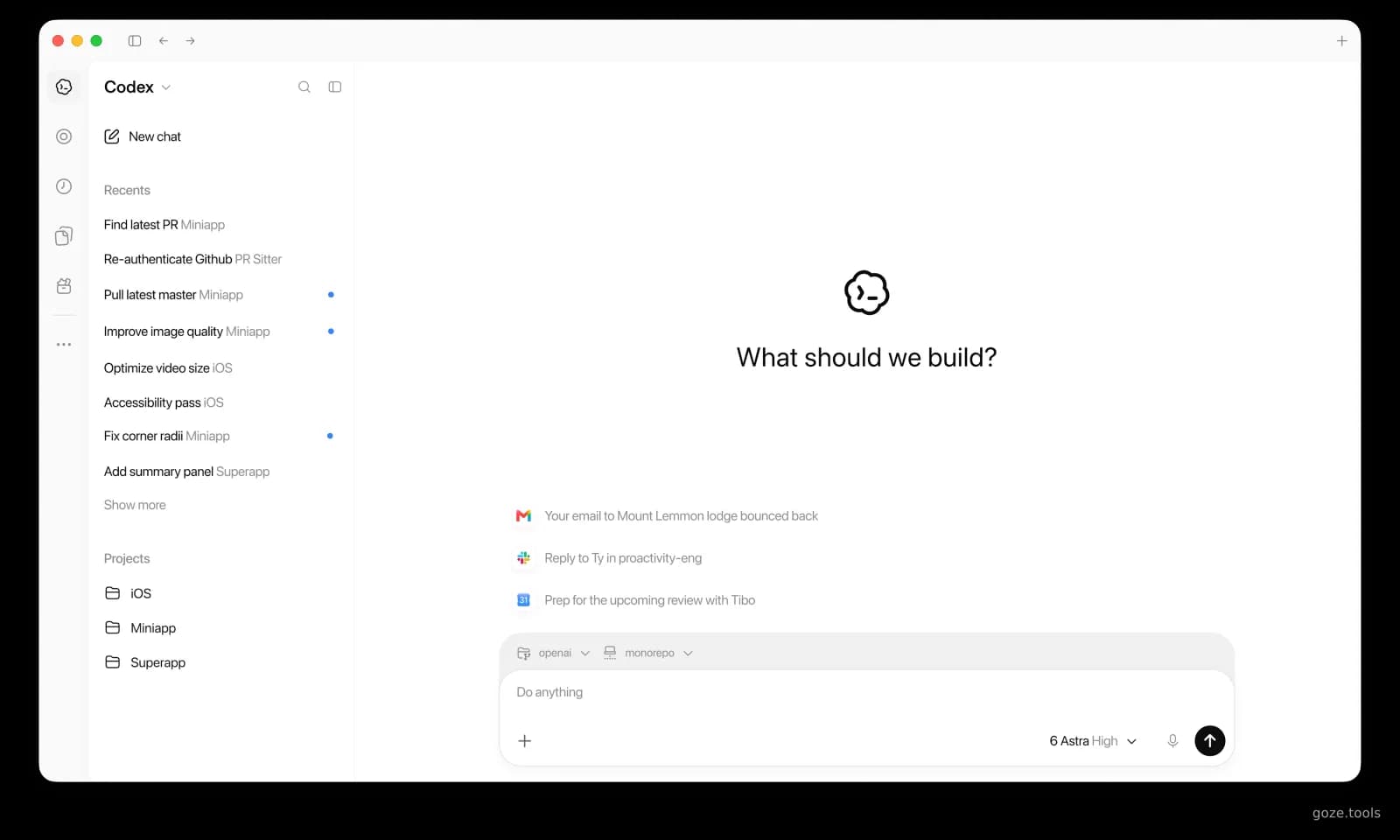
Codex desktop app new task screen.
About OpenAI Codex
OpenAI Codex is a coding agent for software work that depends on a repository rather than a single pasted snippet. It can inspect a codebase, follow project instructions, trace unfamiliar paths, prepare edits across several files, and assist with checks and review. Developers can use Codex through the command line, editor integrations, a desktop experience, or web workflows. The setup, permissions, and available features vary by surface and account type, so the best entry point depends on where the team already works. Codex can reduce the repetitive work involved in implementation, debugging, refactoring, and code review. It performs better when the request is specific and the workspace has clear boundaries. Repository conventions and test coverage still matter because the agent works with the context and tools it receives. Engineers must read the diff, test the behavior, question unsupported assumptions, and decide whether a change is safe to merge. Giving an agent access to a sensitive workspace also requires deliberate permission and data-handling choices. Access ranges from a free plan and paid ChatGPT subscriptions to organization plans and token-billed API use. There is no fixed number of tasks per allowance: consumption changes with task complexity, model choice, execution environment, context size, reasoning, tool calls, retrieval, and caching. ChatGPT plans include some cloud capabilities, while API-key access works with the CLI, SDK, and editor extension without those cloud integrations. Buyers should look beyond the headline monthly price and compare expected workload, review time, workspace controls, data handling, and the surfaces their developers need. The deciding factors are practical: where the agent runs, which repository permissions it receives, how work is reviewed, and whether the selected access route includes the integrations and controls the team needs.
Best for
Best use cases
A developer traces an unfamiliar execution path, updates several related files, and runs repository checks before review.
Independent feature, migration, and review tasks run in separate worktrees or cloud environments while maintainers inspect each result.
A team encodes repository conventions as Skills so repeated coding tasks follow the same local standards and workflow.
Compare before choosing
Compare Codex surfaces by where work runs, which integrations are available, and how repository permissions are controlled.
Compare subscription allowances and token-billed API usage against the complexity and frequency of the expected engineering workload.
Compare review controls, workspace administration, data handling, and cloud features before choosing an individual or organization plan.
Features
Repository implementation
Inspect an existing codebase, follow project instructions, and prepare coordinated implementation and test changes.
Debug unfamiliar systems
Trace behavior across modules, inspect runtime evidence, and narrow a failure before preparing a repair.
Review and refactoring
Analyze diffs, identify behavioral risks, and carry out bounded refactors with repository checks.
Parallel engineering work
Use separate agents, worktrees, or cloud environments to handle independent engineering tasks in parallel.
Pros
- Works with repository context and project instructions instead of relying on a single pasted code snippet.
- Supports implementation, debugging, refactoring, review, and coordinated changes across multiple files.
- Offers command-line, editor, desktop, web, SDK, and cloud-oriented entry points for different team workflows.
- Built-in worktrees and cloud environments support parallel tasks without forcing every task into one workspace.
Cons
- Output quality depends on the repository context, instructions, permissions, and test coverage available to the agent.
- Engineers remain responsible for reading diffs, testing behavior, and deciding whether a change is safe to merge.
- Usage costs and allowances vary with the plan, model, context size, reasoning, tool calls, retrieval, and caching.
- Cloud integrations and administrative controls differ across ChatGPT subscriptions and API-key access.
Pricing Plans
Free
- Quick coding tasks and an entry point for trying Codex
Go
- Lightweight coding tasks
Plus
- Web, CLI, IDE extension, and iOS access
- Cloud integrations and extendable usage with credits
Pro
- Higher usage limits than Plus
- Additional fast coding model access
Business
- Dedicated workspace and administrative controls
- $25 per user per month when billed monthly
Enterprise & Edu
- Enterprise security, controls, audit logs, and usage monitoring
API Key
- CLI, SDK, or IDE extension
- Cloud-based integrations are not included
* Pricing information is for reference only. Please refer to the latest announcement on OpenAI Codex's official website.